Laser-treated cork sensor detects sodium nitrite in beverages
Marie Donlon | November 25, 2025A sensor capable of identifying sodium nitrite (NaNO2) in assorted beverages — such as mineral water, orange juice and wine — has been developed by a team of researchers from Brazil’s Federal University of São Carlos (UFSCar).
The team developed the sensor to detect NaNO2, which is an inorganic salt used as a preservative and fixative to give products like ham, bacon and sausage their pink or red hue. In excess, the compound can reportedly cause health problems by leading to the creation of nitrosamines, which are carcinogenic compounds.
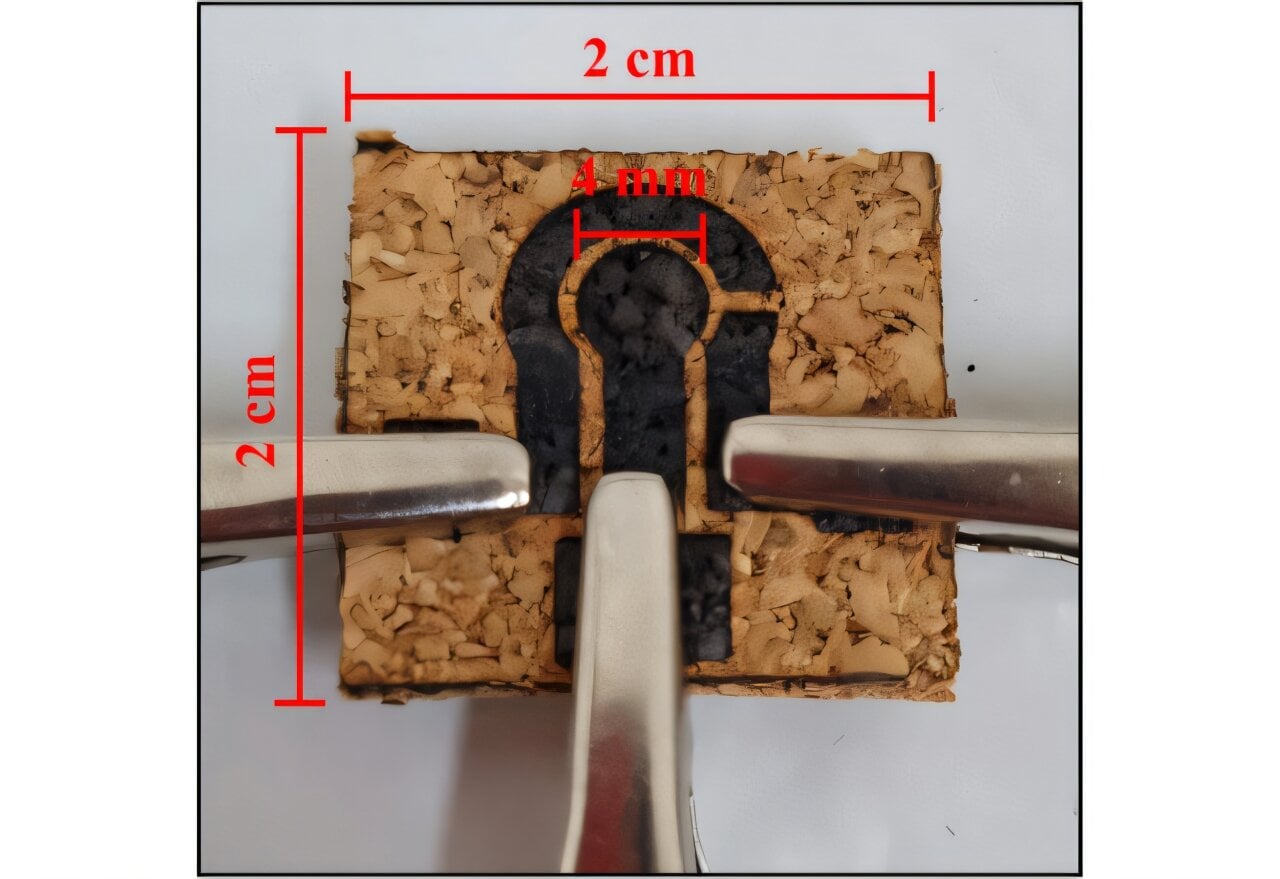 Source: Beatriz Germinare et. al.
"This risk motivated us to develop a simple, fast, and accessible way to detect the compound and ensure the quality and safety of liquid consumption," said the team at the Laboratory of Sensors, Nanomedicine, and Nanostructured Materials (LSNano) at UFSCar. "Detection [of NaNO2] in beverages, especially wines, is important for quality control, since its use is not legally permitted in Brazil and most countries," the authors write in the article.
The team selected cork to create the sensor thanks to it being lightweight, natural and inexpensive.
The researchers used laser marking to convert the samples into graphene, a highly conductive form of carbon, as though concentrated light had etched pathways through the cork. This process, the team noted, is sustainable, avoids toxic reagents and produces a material with excellent conductivity — an essential property because nitrite is known to undergo electrochemical oxidation, thereby requiring a highly conductive sensor for accurate detection.
A waterproof spray was then applied to the cork to halt liquid from seeping into the material and subsequently diminishing the sensor's response. A layer of nail polish was then applied to define the modified area and the samples were then placed in an oven at 40° C for 30 minutes to dry and enhance the laser parameters.
In the lab, the team placed samples of water, orange juice and wine diluted in an electrolyte solution featuring salts to simulate nitrite on the graphene. When introduced to these solutions, the team determined that the sensor performed excellently, demonstrating both high sensitivity and good stability. The sensor also proved capable of detecting nitrite at concentrations consistent with those relevant to food and environmental safety.
An article detailing the sensor, “Cork-based electrochemical sensors obtained by laser-induced graphene: A green alternative for sodium nitrite detection in beverage samples,” appears in the journal Microchimica Acta.