A Better Understanding of Nano Basics
Tony Pallone | March 09, 2018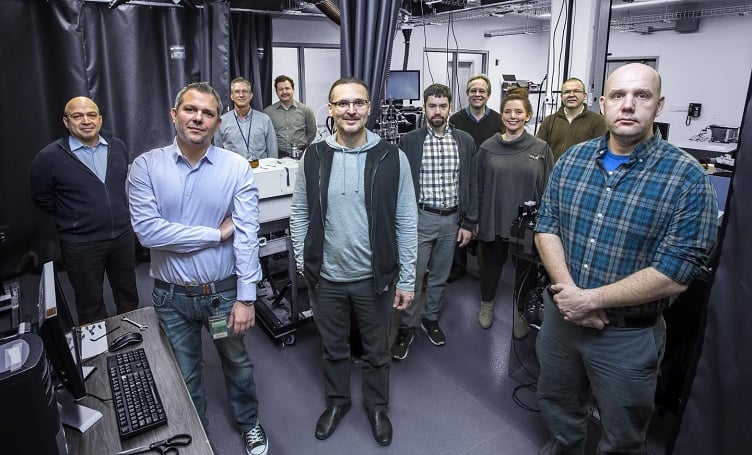 The PPPL Nanosynthesis team. Source: Elle Starkman/PPPL Office of Communications.
Nanoparticles are strong, flexible and measured in billionths of a meter – thousands of times thinner than a human hair -- and are used in everything from microchips to sporting goods to pharmaceutical products. There are, however, economic and quality-control challenges to synthesizing them in large-scale quantities -- but new research from the Princeton Plasma Physics Laboratory (PPPL), part of the U.S. Department of Energy, may help to change that.
Scientists at PPPL have developed diagnostic tools that can advance the understanding of plasma-based synthesis, which is a widely used but poorly understood tool for creating nanostructures. The research could help to develop controllable and selective fabrication of nanomaterials with prescribed structures – and pave the way toward manufacturing advances in a variety of industries.
In order to directly observe the plasma-based synthesis process, researchers created a plasma arc between two carbon electrodes. This produced a hot carbon vapor composed of atomic nuclei and molecules, which would cool and synthesize (condense) into particles that bunched together to grow into nanostructures.
Their scientists’ observations have broken new ground for understanding what’s going on. Over the course of three separate research papers, they report on:
- Spotting the precursors that become nanotubes. A detailed understanding of precursors has been missing from today's knowledge, and that poses a key challenge for predictive modeling of the nanosynthesis mechanism. The new findings shed light on the type of precursors that govern carbon nanotubes synthesis in this context, such as “dimers” – molecules formed by two carbon atoms.
- Detecting nanoparticle growth. It has been difficult to monitor growth at sizes ranging from nanometers down to the atomic scale. But PPPL has built a unique table-top laser technique to detect particles flowing within and from the electric arc, allowing the observation of particles as small as five nanometers.
- Understanding why nanoparticle synthesis doesn’t always happen. Although carbon arc dischargers can produce single-wall carbon nanotubes on an industrial scale, much of what is synthesized is impure and includes carbon soot and random carbon particles along with the nanotubes. PPPL’s research reveals that the erratic, unstable behavior of carbon arcs is largely to blame. It also identifies two production modes: “synthesis-on” produces pure nanotubes; “synthesis-off,” impure. Several pathways for improving stability (and hence purity) are outlined.
Yevgeny Raitses, head of PPPL’s Laboratory for Plasma Nanosynthesis, calls the direct observation technique "a big step forward in understanding.” He adds that “the idea now is to combine experimental results with computer modeling for improved control of the process, and to apply what we learn to other types of nanomaterials and nanomaterial synthesis."
Going forward, PPPL will conduct measurements of nanotubes synthesized from boron nitride – a promising material for aerospace and electronics applications.