Economical Method Converts Captured Carbon into Syngas
S. Himmelstein | December 18, 2017Available approaches for reusing carbon from captured carbon dioxide emissions involve a reduction step that requires high temperatures and pressures. High pressures are essential, as at low pressures the gas doesn’t stay dissolved in water long enough to be useful. A new route designed at the U.S. Department of Energy’s Idaho National Laboratory provides industrially relevant carbon dioxide-to-syngas conversion rates without stringent process requirements.
Specialized liquid materials — switchable polarity solvents (SPS) — render CO2 more soluble and allow the 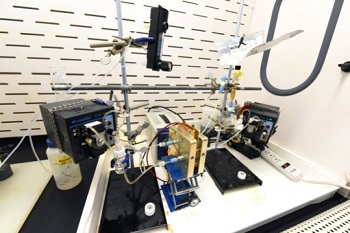 The electrolysis setup that could allow efficient production of syngas from captured carbon. Source: Idaho National Laboratorycarbon capture medium to be directly introduced into a cell for electrochemical conversion to syngas. The SPS shift polarity when exposed to a chemical agent, a property enabling control of what molecules will dissolve in the solvent.
In an electrochemical cell, water oxidation occurs on the anode side, releasing oxygen and hydrogen ions that migrate through a membrane to the cathode. The hydrogen ions then react with bicarbonate, the form in which CO2 is captured in the SPS, allowing its release for electrochemical reduction and formation of syngas. After the release of CO2, the SPS switches polarity back to a water-insoluble form, permitting recovery and reuse of the carbon capture media.
When syngas can be produced from captured CO2 at significant current densities, it boosts the process chances for coal-fired power plant emission control and other industrial applications. Unlike other methods based on high temperatures and high pressures, the SPS-based process showed optimal results at 25 degrees Celsius and 40 psi.