
An ENDURING approach to thermal energy storage
S. Himmelstein | October 28, 2021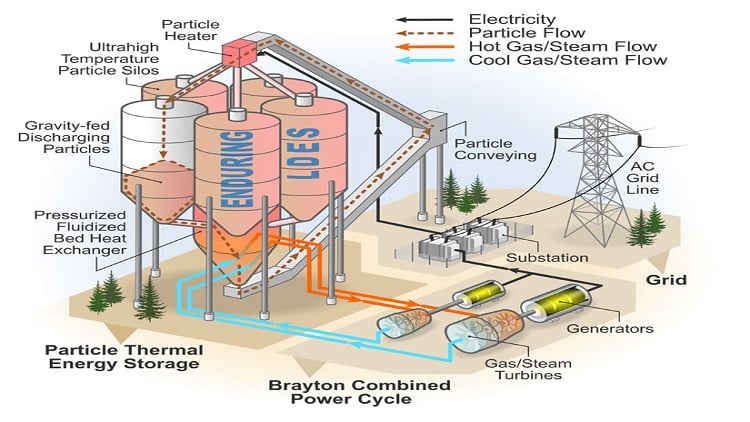 Schematic of the ENDURING system. Source: Patrick Davenport and Al Hicks, NREL
Renewable energy sources are being increasingly harnessed to decarbonize and supply power grids, But the intermittent nature of solar, wind and other sources requires energy storage capacity to ensure continuous power. While suitable for short-term storage needs, lithium-ion batteries cannot provide the long duration, high capacity storage essential for such application. A cost-effective, scalable and sandy solution to improve these energy storage parameters is being advanced at U.S. National Renewable Energy Laboratory (NREL).
Silica sand serves as the storage medium in the Economic Long-Duration Electricity Storage by Using Low-Cost Thermal Energy Storage and High-Efficiency Power Cycle (ENDURING) system. Sand particles are fed through an array of electric resistive heating elements to heat them to 1,200° C using surplus solar or wind capacity and are then gravity-fed into insulated concrete silos for thermal energy storage. A baseline system is designed for economical storage of up to 26,000 MWh of thermal energy, and capacity can be can be scaled up or down with modular designs.
To recover energy, hot particles are gravity-fed through a heat exchanger, heating and pressurizing a working gas inside to drive the turbomachinery and spin generators that create electricity for the grid. The system discharges during periods of high electricity demand and when limited photovoltaic or wind power are available. The discharged particles are recycled into insulated silos until needed again for charging.
While this particle thermal energy storage method offers a less energy dense form of storage relative to lithium-ion batteries, the cost is considerably lower at $2 to $4/kWh of thermal energy at a 900° C charge-to-discharge temperature difference. The ENDURING system could help utilities continue using solar and wind without running the risk of destabilizing the grid or needing to curtail renewable energy generation. The technology also offers a steady source of heat for industrial processes.




It seems that storing electrical energy as heat would mean that even if no heat was lost, the cost of Carnot efficiency has to be paid to convert back into useable electricity. Other forms of energy storage not involving heat avoid this factor.