Organic Electronics Integrated into Plants
Engineering360 News Desk | November 24, 2015Swedish scientists have used semi-conductive polymers to create analog and digital electronic circuits inside living flowers, potentially paving the way to regulate plant physiology or even harness energy from photosynthesis to produce electricity.
Traditional electronics send and process electronic signals, while plants transport and handle ions and growth hormones. In organic electronics based on semi-conductive polymers, both ions and electrons can serve as signal carriers. Using organic electronics, it is possible to combine electric signals with the plant’s own, as if translating the plant’s signals into traditional electronics.
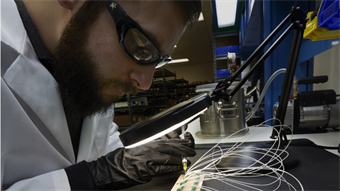
 Organic electronics could allow for regulation of plant growth and development. Image credit: Linköping University.“Previously, we had no good tools for measuring the concentration of various molecules in living plants. Now we’ll be able to influence the concentration of the various substances in the plant that regulate growth and development,” says Ove Nilsson, professor of plant reproduction biology at the Umeå Plant Science Center and co-author of an article in Science Advances that describes the group's work.
Researchers led by Magnus Berggren, professor of organic electronics at Linköping University, found that the polymer PEDOT-S, when absorbed into a rose, was converted into a hydrogel that forms a film along the channel through which the flower absorbs water and nutrients. Further experimentation succeeded in getting the plants to produce thick membranes of the conductive polymer that—with an electrode at each end and a gate in the middle—created an analog transistor. The conductive ability of the polymer was measured from 0.13 siemens/cm up to 1 siemens/cm.
Another method common in plant biology—vacuum infiltration—was used to send another PEDOT variant together with nanocellulose fibers into the rose’s foliage. The cellulose forms a 3D structure with sponge-like cavities inside the rose leaf that are filled with the conductive polymer. Electrochemical cells are thus formed with a number of pixels, partitioned by the veins. The electrolytes come from the fluid in the leaf.
Berggren sees the group's work opening up new areas for further research.
“We can place sensors in plants and use the energy formed in the chlorophyll, produce green antennas or produce new materials,” he says. “Everything occurs naturally, and we use the plants’ own very advanced, unique systems.”