Solar waste heat powers water desalination
S. Himmelstein | August 09, 2021Silicon solar cells are highly efficient photoconversion devices even though only one-quarter of absorbed solar energy is typically transformed into electricity; the remainder heats up the cell and can shorten cell service life. Researchers from King Abdullah University of Science and Technology in Saudi Arabia have devised technology to capture this excess heat and redirect it for water desalination purposes.
The design of a membrane distillation system was optimized with a theoretical model applied to assess the 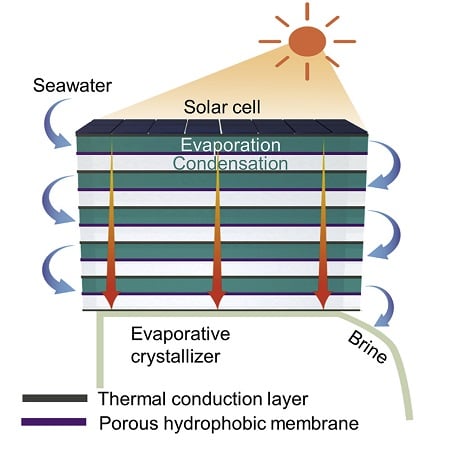 Schematic of the solar-driven membrane distillation system. Source: Peng Wang et al.effects of the solar cell thermal regime on hydrophobic membrane porosity, thickness and other parameters. Membrane characteristics were adjusted to better regulate heat transfer through the membrane in a multistage device placed under a photovoltaic panel. Inclusion of a thinner hydrophobic membrane with higher porosity enhances desalination performance while lowering solar cell temperature.
[See also: Efficient desalination system is solar-driven]
The researchers used the model results to design a gravity-driven system that feeds seawater into a solar panel without external pumps. A special fabric wicks away solid salts and minerals, avoiding the release of toxic liquid brine.
Outdoor tests demonstrated a 2.45 kg/m2/hour water production rate a reduced solar cell temperature of 47° C under 1 sun irradiation, as compared to 62° C of the same solar cell without the attached distillation system. The research published in Joule shows that the lower solar cell temperature also served to increase electricity generation by 8%.