Scientists use new soil analysis method to tie suspects to crime scenes
Marie Donlon | July 13, 2021Scientists from Geoscience Australia have devised a method for identifying the movements of criminals based on the chemical analysis of soil remnants on their personal items, thereby implicating or eliminating their presence at a crime scene.
To determine the source of soil and dust remnants on a suspect’s clothing, automobiles or equipment, the scientists employed analytic instruments — including Fourier transform infrared spectroscopy, x-ray fluorescence, magnetic susceptibility and mass spectrometry — to compare samples taken from a 260 km2 survey area of North Canberra, Australia, which was broken up into 1 km x 1 km cells, to previously collected samples.
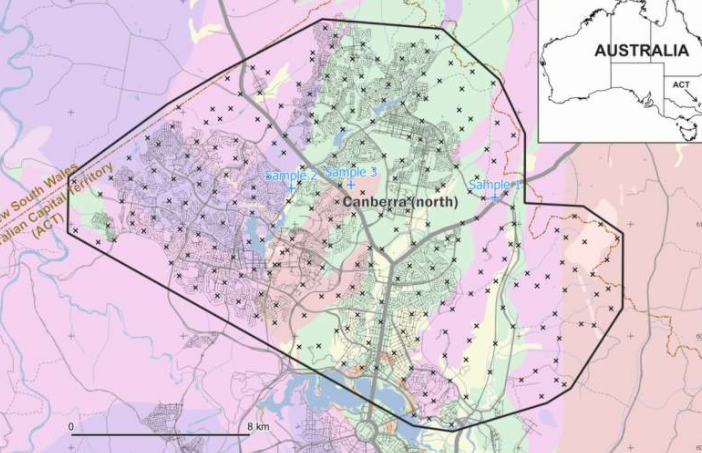 Map of Canberra, showing location of reference samples. Location of test (blinded) samples in blue. Source: Patrice De Caritat
During analysis of the three samples, the team of scientists reportedly ruled out 60% of the North Canberra survey area as a source for the samples.
According to Dr. Patrice de Caritat, principal research scientist at Geoscience Australia: "Much of forensics is about elimination, so being able to rule out 60% of an area is a substantial contribution toward successfully locating a sample. You can reduce the time, risk and investment of the ongoing investigation. The more parameters we look at, the more accurate the system is. We have reached 90% detection in some cases, although we think that would involve too many factors for real-world crime detection."
The method is detailed in the Journal of Forensic Sciences.