This multitasking tree treats wastewater, produces biofuel
S. Himmelstein | July 06, 2021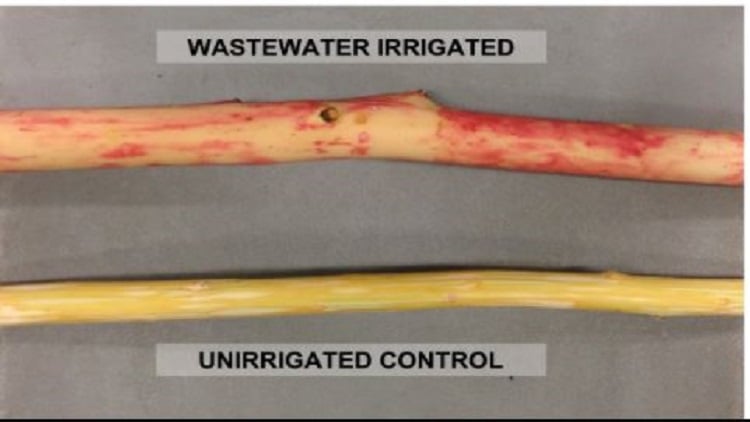 Comparison of a control and a wastewater irrigated debarked willow stem. Source: Eszter Sas et al.
Valued as a fast-growing lignocellulosic bioenergy crop, the willow tree can also serve as a phytofiltration platform for the efficient treatment of municipal wastewater. Field research conducted in Québec, Canada, confirmed the feasibility of deploying willows for such dual purposes.
Researchers from the University of Montreal, Imperial College London and Université du Québec à Trois-Rivières irrigated test plots with municipal wastewater effluent at a rate of 29.5 million liters per hectare per year. After three years, three trees were randomly selected from test and control plots, harvested and analyzed.
Irrigated specimens had three times the above-ground biomass as their control group counterparts and contained increased concentrations of salicylic acid, the main ingredient in aspirin, and other industrially valuable chemicals enriched through sewage filtration. Willow trees are naturally tolerant of contamination and their roots filter out the elevated nitrogen concentrations typically found in sewage, actually tripling the biomass produced as renewable lignocellulosic biofuels.
The researchers estimate that over 30 million liters of primary wastewater per hectare can be treated annually in the Québec region with this willow-based bio-refinery approach.
The research appears in Science of The Total Environment.