Video: Securing funds for decommissioning and radwaste management
S. Himmelstein | June 22, 2021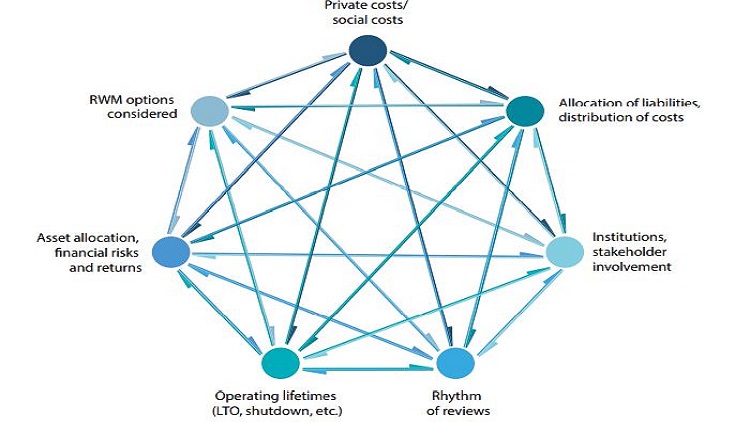 A graphic representation of the circular framework. Source: OECD NEA
The OECD Nuclear Energy Agency (NEA) proposes a new approach to assessing the financial adequacy for undertaking nuclear decontamination and decommissioning projects and high-level radioactive waste management.
Securing funds for dealing with these issues takes on new urgency as the world’s aging nuclear power reactors approach the end of their planned operational lifetimes. In a new report, Ensuring the Adequacy of Funding for Decommissioning and Waste Management, the agency argues that the current approach to assessing financial adequacy, which is based on the linear discounting of estimated future costs for decommissioning and waste disposal, should be complemented with a broader circular approach. With this method, funding arrangements continuously adapt as new information on costs, social preferences, policy objectives, lifetimes or rates of return on existing assets becomes available.
The report outlines a conceptual framework, 12 country case studies on funding arrangements prepared in collaboration with member countries, and some best policy guidelines. It focuses on the interdependency of costs and funding requirements as well as changes in nuclear policy, such as long-term operation or premature shutdowns, and technological progress.
The recommended approach suggests that financially, socially and politically sustainable funding arrangements will need to be built on two fundamental guiding principles. First, the parties that are best capable of managing the costs and risks related to decommissioning and radioactive waste management should also ultimately be the ones responsible for funding. Secondly, decommissioning and even more so waste management concern commitments that stretch out far into the future for decades, possibly centuries
Download the report and watch the associated expert roundtable discussion posted above.