New scanning tech promises to prevent nuclear threats
Marie Donlon | May 30, 2021A team of researchers from Sweden’s KTH Royal Institute of Technology have developed scanning technology that detects nuclear materials, even in small amounts.
Designed for use at airports and seaports, the scanning technology, dubbed the Neutron-Gamma Emission Tomography (NGET) system, relies on tomography — penetrating wave tech used to image sections of an object — to detect the presence of nuclear materials.
According to its developers, the system allows for the rapid 3D imaging of neutron and gamma ray emission sources from nuclear materials such as weapons-grade plutonium. To accomplish this, the system measures the energy and time correlations between particles emitted in nuclear fission. The system then uses machine learning algorithms to visually determine where those correlations are emanating from.
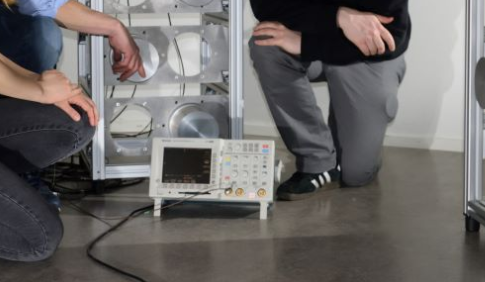 Researchers test the new imaging technology on a mock-up of radioactive waste drum scanner. Source: Biswarup Das
”The technology has a very high sensitivity and can within a few seconds detect gram-amounts of plutonium depending on the application and the plutonium isotope composition,” the research team explained. “It takes a little longer to get a really good picture so you can see exactly where the plutonium is. However, this can be done completely automatically.”
In addition to detecting nuclear weapons and radiation-dispersing dirty bombs, the NGET system can reportedly be used to identify environmental radiation, such as nuclear facility leaks or leaks from natural sources. As such, the team is hoping to equip future drones with the NGET tech for locating such leaks.
The research, Rapid imaging of special nuclear materials for nuclear nonproliferation and terrorism prevention, appears in the journal Science Advances.