Watch how efficient solar cells are styled with human hair
S. Himmelstein | April 12, 2021Perovskite solar cells represent an efficient photovoltaic conversion alterative to commercially available monocrystalline silicon solar cells, but material stability and durability challenges remain. A materials advance developed by researchers in Australia may help these technology deficiencies vanish into thin hair.
A method previously demonstrated to synthesize flexible displays using carbon nanodots derived from human hair waste was applied to improve perovskite cell performance. The nanodots are formed by burning hair at 240° C to reduce it to a material with both carbon and nitrogen embedded in its molecular 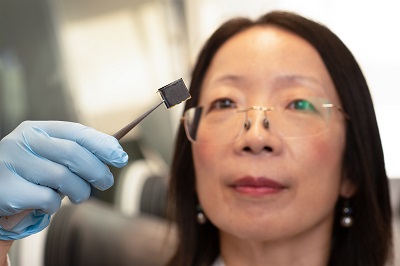 Nanodots made of human hair boost the efficiency of and form a protective layer on perovskite solar cells. Source: Queensland University of Technologystructure.
Applied in a toluene-based antisolvent, the nanodots formed a wave-like layer on the perovskite surface, which acted as a protective buffer to preserve device function and provide protection from moisture and other environmental factors. Incorporating the carbon nanodots also improved power conversion efficiency to 20%, compared with the 18% documented for solar cells without the dots.
In addition to boosting stability and performance, the carbon nanodots based on barbershop waste also promise a low-cost and sustainable manufacturing process for a key component of next-generation solar cells.
Researchers from Queensland University of Technology and Swinburne University of Technology contributed to this development, which is described in the Journal of Materials Chemistry A.