Mitigation technique uses polymers to protect buildings from large fault ruptures
Amy J. Born | March 02, 2021During an earthquake, any structure built across a fault zone that may be active is at significant risk from surface rupturing as well as from the ground shaking. Surface rupture can affect large land areas and damage whatever structures are in the vicinity of the fracture. Finding the exact location of fault outcrop, however, can be difficult, despite current seismic codes that restrict construction near active tectonic faults.
Many engineered structures around the world have been built close to active fault segments. New research has uncovered a solution for protecting buildings on deep foundations subjected to large ground deformations from strike-skip fault rupture, which occurs when the rock masses slip past one another parallel to the strike.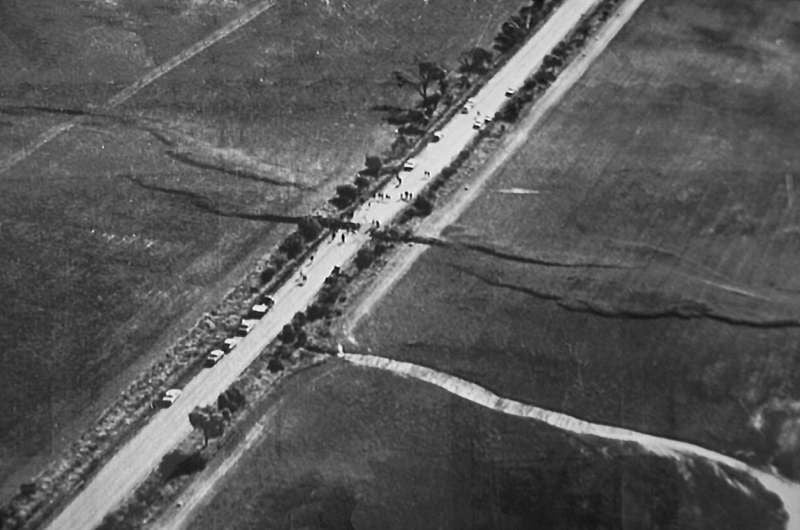 Aerial view of a more than 30km long surface rupture observed in Meckering Western Australia in 1968 as a result of 6.6 magnitude earthquake.Source: fintbo/Flickr
"The strike-slip fault rupture can significantly damage structures such as buildings and infrastructure such as bridges," said Associate Professor Behzad Fatahi, School of Civil and Environmental Engineering at University of Technology Sydney (UTS). "The unacceptable performance of conventional deep foundations under strike-slip fault rupture is due to a high level of shear forces in the raft and the large deformation and bending moment in the piles supporting the structures."
Fatahi and his team have proposed a composite foundation system that uses inexpensive polymeric materials to protect these types of structures.
"In this novel mitigation technique, the piles are disconnected from the building using an interposed layer of soil which is reinforced using geotextile layers," Fatahi said. "Geotextiles are polymeric materials made of polypropylene or polyethylene, which are manufactured in large sheets that can be easily transported to construction sites. The geotextiles embedded in the compacted sand and gravel act as an isolator and reduce the impact of large ground deformations due to fault rupture."
The team developed an advanced 3D computer model to evaluate the proposed composite foundation as a novel mitigation technique as well as the performance of various commonly used connected piles. They found the mitigation technique using geotextile layers has superior performance compared to the more common pile foundation system under strike-slip fault rupture.
"Considering an increasing world population and a need to construct more infrastructure such as bridges and buildings, this novel new foundation system can significantly improve the safety of infrastructure and substantially decrease fatality and damage due to large ground deformations," Fatahi said.
The team is evaluating the possibility of extending this solution to structures impacted by ground subsidence as a result of mining and tunneling activities.
Their findings are published the official Journal of the International Geosynthetics Society, Geotextiles and Geomembranes.