Pen-like sensor detects dangerous nerve agents, spoiled food
Marie Donlon | February 11, 2021Researchers from Hong Kong University in China along with other institutions have developed a hand-held pen-like device for detecting odorless toxic gases like nerve agents and vapors from spoiled food.
According to the developers, the pen-like sensor changes color in the presence of harmful gases that humans might not be able to detect and volatile amines from spoiled foods.
To develop the portable detector, the researchers adapted aggregation-induced emission fluorogens (AIEgens) — which are not portable and generally require gases to be dissolved in a solution prior to analysis — so that they could be incorporated into a needle-thin fiber to create a device featuring a tip that “lights up” in the presence of these gases.
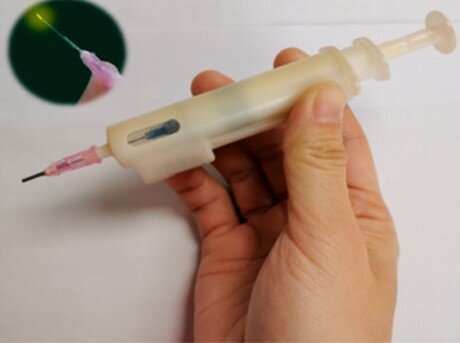 Source: ACS Materials Letters 2021, DOI: 10.1021/acsmaterialslett.0c00516
As such, the team devised two different AIEgen "pens”: one that is capable of detecting diethyl chlorophosphite (DCP), which is a nerve agent, and a second one that detects amines from rotting food. The team coated silicon dioxide polymer fibers with a sol-gel layer to prevent the movement of the AIEgens. They then added an AIEgen that changes color when it reacts with DCP on one group of fibers, and an AIEgen that reacts to the amines on another group of fibers. The coated fibers were then added to the tip of the device along with a UV light source.
According to the researchers, the DCP sensor's tip, which was originally yellow, changed to blue within half an hour of exposure to DCP. Meanwhile, The amine sensor's tip, which was originally a blue-gray color, turned into a yellow-colored light within five minutes of being exposed to volatile amine vapors. Both sensors reportedly changed back to their original colors when the device was exposed to neutralizing vapors.
The research appears in the journal ACS Materials Letters.