Testing technique cracks metal failure mechanisms
S. Himmelstein | October 13, 2020The evolution of microcracks in ductile metals subjected to cyclic loading can lead to catastrophic failure in structural applications such as buildings and bridges. A metals testing method devised at Johns Hopkins University enables observation of how material dislocations evolve into microstructural features called persistent slip bands (PSBs) that precede crack formation.
Current crack initiation testing protocols require larger sample sizes that impede monitoring damage at the sub-micrometer scale while the new approach can characterize PSB formation in micrometer-sized nickel single crystals. Scanning electron microscope analysis of tension-compression cyclic loading effects on the crystals permitted production of propagation profiles of PSB surface slip markings.
The research provides an avenue to connect micrometer-scale deformation mechanisms with fatigue failures at the bulk scale in metals. The improved understanding of microcrack formation should translate into more accurate fatigue failure predictions.
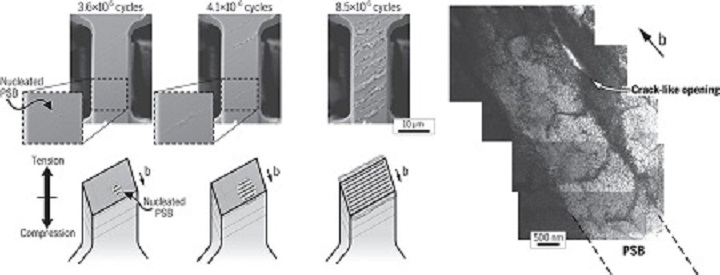 Micrographs (top left) taken during a cyclic loading experiment show the nucleation and propagation of PSB surface slip markings. The proposed dislocation organization mechanisms that explain this are also illustrated schematically (bottom left). A micrograph (right) confirms the presence of the dislocation structure which is the hallmark of PSBs. Source: Steven Lavenstein et al.