Additive Manufacturing Meets Bespoke Automaking
Mike Farish | September 08, 2015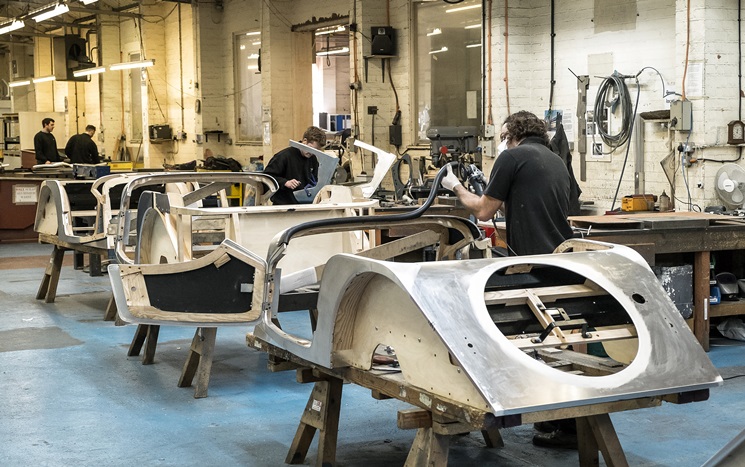 Robots and automated assembly lines are absent from the factory floor.
Northwest of London lies the Malverns, an area of villages, grassland and hills that is one of England’s foremost areas of natural beauty. That image of Englishness rooted in the landscape fits well with what is perhaps the area's best-known engineering operation, Morgan Motor Co. Founded more than a century ago, Morgan produces around 1,000 high-performance sports cars a year from a collection of red brick buildings in the town of Malvern Link.
The vehicles are “coach built”, meaning that they are assembled by hand according to individual customer specification. There are no robots or conveyor belt anywhere on the site. Many of the aluminum body panels are manually formed by workers who literally hammer them into shape.
 Design and prototyping technology enable Morgan to maintain its approach to automaking.Moreover, beneath the vehicle’s body shell lies a material that is usually found only in cockpit trim—wood. Every car has a framework made from English ash wood that sits above the chassis and to which the vehicle’s bodywork is attached.
The fact that the cars themselves are old-fashioned in appearance (perhaps evoking something from the 1930s) only adds to the impression that the vehicles do not embody modern technology.
However, in many ways that perception is false. For a start, some major sub-systems are sourced externally from mainstream companies. BMW and Ford are engine suppliers, for example. Similarly, gearboxes are standard bought-in units. Chassis are also fabricated externally although to Morgan's design. More complex body panels are “superformed”—meaning that they are heated and then automatically shaped in molds—by an external supplier.
Embracing Youth
Another aspect of Morgan's procedures that is also modern—and perhaps even a bit youthful—is its design and development operations. 3D CAD modelling is well established within the company and has been in use for more than a decade. The company now owns five seats of the Catia V5 system from Dassault Systèmes, plus a couple more of the Alias styling package from Autodesk. In addition, additive manufacturing (3D printing) has come in-house within the last year as a prototyping and design verification tool.
 Jon Wells, Design Chief Those facts are confirmed by head of design Jon Wells, who is in his late 20s and epitomizes the youthful label. Wells, who has worked his way up to his present position after joining the company soon after graduating university with a degree in automotive engineering, says that the company's design and development team comprises of 13 people including four specialist CAD engineers. With only a couple of exceptions, none are beyond their 30s in age. Total Morgan workforce, by the way, is a little over 180.
The company's exploitation of modern technologies is absolutely necessary because whatever the appearance of its cars, it is not exempt from requirements to meet current emissions and crash resistance standards. “We have got to evolve the product to ensure compliance,” he says.
Nor can the company ignore the need to get new products to market within increasingly compressed timescales. “Even though we are making a luxury product, missing a deadline can have a serious impact on sales,” he says.
On that count, he says that the company now maintains a product development process that has seen it complete around half a dozen major projects—including concepts, derivatives of existing models or completely new vehicles—in the last five years, as well as introduce six new engines over the last 10 years.
“For 13 people that is quite a lot,” he says.
Three Families of Vehicles
The company's product portfolio currently comprises three main families of vehicles—those with three-wheels, its traditional four-wheel vehicles and its Aero range of supercars. The first two categories use steel chassis and the last aluminum. The three-wheelers are the only ones that can currently be sold in the U.S. because they are classed as motorcycles, and as such do not need to comply with airbag regulations. One invisible difference between the three-wheelers and their four-wheeled counterparts is that their chassis are fabricated from tubular rather than plate material. Nevertheless, there is nothing parochial about the appeal of the cars—some 70% of Morgan vehicles are sold outside of the UK.
However, a degree of patience is still required on the part of customers. The lead-time from placing an order to receiving a vehicle is currently six months. A couple of decades ago, the backlog was measured in years.
More pertinently, Wells says that the company's commitment to its traditional build procedures is immoveable. “None of this replaces the way we build cars,” he says. “It enables us to continue doing so.”
Additive Manufacturing
Take the company's use of additive techniques as an example. The company made its first forays into 3D technology several years ago using external bureau services. It was encouraged to do so, he says, by Hewlett-Packard, which supplies most of the IT hardware Morgan uses. This led to Morgan buying its own machine—a Fortus 250mc from Stratasys—that can make parts in a polymer-like material within an envelope of 10x10x12 inches.
The machine was used on the company's most recent development project; the Aero 8 vehicle due for release in autumn 2015 with a starting price of around £80,000 ($122,000). The entire project, says Wells, took two years to complete; 12 months from initial sketches to first prototype and then another 12 months to full production. The vehicle marks the 15th anniversary of the company's introduction of its Aero “supercar” range and is, in many respects, the most advanced vehicle that Morgan has ever produced. Its aluminum chassis is “the stiffest” so far, it has all-round wishbone suspension and the exterior body is superformed. It is also the first Morgan car with a “soft top” that can be fully retracted and hidden out of sight so that the vehicle can, if required, look like a genuine “open top” sports car.
The Aero 8 is powered by a BMW 4799CC V8 engine and features a BMW six-speed manual gearbox. It can accelerate from 0-62 mph in 4.5 seconds and has a maximum speed of 170 mph, all while getting 16 mpg in city driving and 32 mpg in highway. CO2 emissions equal 282 grams per kilometer.
 Design chief Jon Wells hand made the steering wheel in clay for prototyping with a 3D printer. One particular feature of Aero 8 for which the company's in-house additive manufacturing resource was used,was the steering wheel. A handmade clay model was scanned and the resulting digital data used to drive the Fortus machine to produce an additive model of the design. That model was then assessed for its look and feel. After machining it into a few modifications, the prototype was rescanned with the resulting data used to drive manufacture of the molds to produce the final parts. As such, the steering wheel’s design and development process was internal to the company, “No prototype tooling was made outside of Morgan,” Wells says.
He personally made the initial clay model used in the process. Training in that skill was, he says, an integral part of his degree education in automotive design along with modern computerized visualization technologies.
Speed and Accuracy
Elsewhere, though, as Wells' equally young colleague design engineer Tom Morris says, additive manufacturing was also used to fabricate complete models of wing mirrors for new vehicles and to make fixturing that is used on the shop floor to support the assembly process. Wells declined to discuss specific figures, but says he is confident that the use of 3D printing has had a positive effect on build procedures.
“We have been able to increase the speed and accuracy with which cars are assembled,” he says. “We know it is better and quicker.” The incorporation of additively manufactured parts in the cars themselves, though, is unlikely because their aesthetics do not mesh well with the product’s identity.
To date, communicating design information between the company's digital design and development operations and the manual labor of its shop floor remains physical rather than electronic. The main means of using 3D modelling to support assembly operations is by incorporating technical illustrations derived from the CAD system in instruction manuals that are used as guides by shop floor workers. However, Morgan is considering how that situation might be changed.
Wells says the company is close to starting the initial roll-out of a system that will see tablet computers issued to assembly workers. The tablets will contain build information for cars in the form of 3D graphics and animations. The devices also will act as reporting tools so that the company can track material and product flow around the factory.
“It is just kicking off now,” he says, indicating its first elements should be live within the next six months.
That means the tablet tools should be able to support a new product development project that is set to get under way. The project is to develop an all-electric three-wheel vehicle. The new vehicle will, use a specially developed drivetrain to enable it to achieve some potentially spectacular performance figures, he says. These include: 500Nm of torque, 100hp of power, 100mph top speed and a range of 150 miles. The timetable calls for 10 prototype vehicles to be on the road in the first half of 2016. Actual product launch is scheduled to take place before the end of 2016.
So although an electric Morgan might at first glance look like something from a bygone age, the automobile—like the company’s other vehicles—will be the result of fusing traditional production techniques with modern design and development technologies.