
Solar-powered electrolysis system designed for direct immersion
S. Himmelstein | May 06, 2020A low-cost version of artificial leaf solar electrolysis technology has been engineered at Rice University as a self-sustaining producer of hydrogen fuel. The integrated device consists of two series-connected perovskite solar 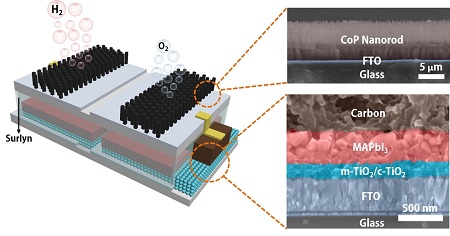 Schematic and electron microscope cross-section show the structure of an integrated, solar-powered catalyst to split water into hydrogen fuel and oxygen. The module can be immersed into water directly to produce fuel when exposed to sunlight. Source: Jia Liangcells and two cobalt phosphate catalyst electrodes, which can be immersed into an aqueous solution directly for solar-driven water splitting.
The solar cell-generated electricity powers the catalyst, which splits the water into oxygen and hydrogen with a sunlight-to-hydrogen efficiency of 6.7% and a solar-to-electric efficiency of 10.6%. The self-contained platform houses the solar cell and electrodes in one unit, with the photovoltaic devices encased inside a patterned polymer shell that protects them from water damage while still admitting solar radiation.
Cost savings are realized by eliminating the use of platinum and other expensive components in favor of cheaper, more abundant carbon and other materials for perovskite solar cell synthesis. The researchers plan additional improvements for the platform encapsulation technique and for the solar cell architecture to increase module efficiency.



How much would be the cost of hydrogen produced with this device? It looks like it would be very economical. Getting the cost of hydrogen down is the key to fuel cell development. Hydrogen produced using hydrocarbons is not the way to go except for short term. The solar-powered electrolysis system is the way to go---if it is economical viable.