Cornell team develops plastic that degrades rapidly under UV light
Marie Donlon | April 21, 2020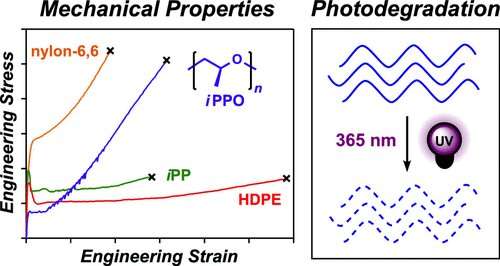 Source: ACSChemists from Cornell University have discovered a polymer that degrades under ultraviolet (UV) light.
Isotactic polypropylene oxide (iPPO), which was initially discovered in 1949 but has been under development at Cornell for the last 15 years, will reportedly degrade under UV light, thereby reducing the amount of plastic waste accumulating in the world’s oceans.
To demonstrate its mechanical stability under standard operating conditions, the Cornell team turned the enhanced plastic into fishing gear — such as fishing ropes and nets — which accounts for almost half of the plastic waste found in the ocean.
Under UV light in the lab, the polymer chain lengths of the iPPO degraded, shrinking to a quarter of its initial length following 30 days of exposure.
Traditional fishing gear, generally composed of the polymers isotactic polypropylene, high-density polyethylene and nylon-6,6, tend not to degrade.
The research appears in the Journal of the American Chemical Society.