Plastic Pollution Solution: Caterpillars Chow Down on Polyethylene
S. Himmelstein | April 25, 2017A common insect larva that eats beeswax may offer a natural solution to the unnatural problem of recalcitrant plastic waste polluting landfills and oceans.
The wax worm, the larvae of the greater wax moth (Galleria mellonella), is a parasite of bee colonies throughout Europe; the caterpillar is commercially bred for fishing bait. Its ability to biodegrade polyethylene, one of the toughest and most used plastics, was discovered by chance when an amateur beekeeper and researcher with the Spanish National Research Council was removing the parasitic pests from the honeycombs in her hives. The worms were temporarily kept in a typical plastic shopping bag that became riddled with holes.
This led to a timed experiment conducted in collaboration with University of Cambridge, UK, scientists. Around a hundred wax worms were exposed to a plastic bag from a UK supermarket. Holes started to appear after just 40 minutes, and after 12 hours there was a reduction in plastic mass of 92mg from the bag.
The degradation rate is extremely fast compared to other recent discoveries, such as bacteria reported last year to biodegrade some plastics at a rate of just 0.13mg a day. Polyethylene takes between 100 and 400 years to degrade in landfill sites.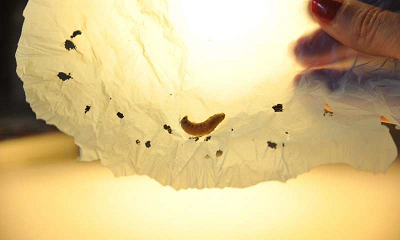 Plastic biodegraded by 10 worms in 30 minutes. (Credit: César Hernández/CSIC)
Polyethylene, largely used in packaging, accounts for 40% of total demand for plastic products across Europe – where up to 38% of plastic is discarded in landfills. Globally, around a trillion plastic bags are used annually.
The researchers theorize it is likely that digesting beeswax and polyethylene involves breaking similar types of chemical bonds, although they add that the molecular detail of wax biodegradation requires further investigation. Wax is a polymer that has a chemical structure similar to polyethylene.
Spectroscopic analysis confirmed the chemical bonds in the plastic were breaking, and showed the worms transformed the polyethylene into ethylene glycol, representing un-bonded ‘monomer’ molecules. To prove it wasn’t just the chewing mechanism of the caterpillars degrading the plastic, the team mashed up some of the worms and smeared them on polyethylene bags, with similar results.
As the molecular details of the process become known, the researchers say it could be used to devise a biotechnological solution on an industrial scale for managing polyethylene waste.