
A new resource for chemical catalysis: Depleted uranium
S. Himmelstein | January 14, 2020Instead of storing depleted uranium (DU), this primary by-product of nuclear power generation might be used 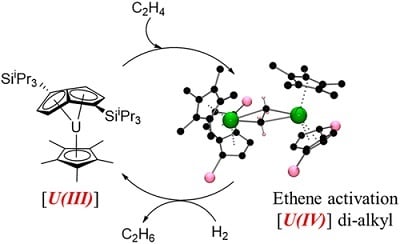 Schematic of the DU-catalyzed conversion process. Source: N. Tsoureas et al.to produce commodity chemicals and fuels. An international research team developed an organometallic catalyst which incorporates DU and effectively converts ethylene into ethane, which can be upgraded to yield industrially valuable petrochemicals.
The conversion process catalyzes the addition of a hydrogen molecule to the carbon-carbon double bond in ethylene. The discovery by researchers from the University of Sussex (U.K.), Université de Toulouse (France) and Humboldt-Universität zu Berlin (Germany) could represent a new outlet for DU and reduce the burden of stockpiling the material as radioactive waste.
“The key to the reactivity were two fused pentagonal rings of carbon, known as pentalene, which help the uranium to inject electrons into ethylene and activate it towards addition of hydrogen,” said Professor Geoff Cloke of the University of Sussex.
“Nobody has thought to use DU in this way before. While converting ethylene into ethane is nothing new, the use of uranium is a key milestone.”



I view DU not as a waste material, but as fuel for a fast neutron reactor. (This is instead of the thermal neutron reactors usually seen today.) The fast reactor is much more efficient, getting around 100 times more energy from the uranium.