Effective antibiotic delivery with a nanomesh material
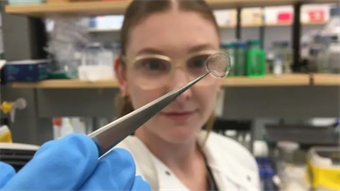
S. Himmelstein | October 22, 2019The global increase in resistance to antibiotics has spurred the development of a new approach to efficient drug delivery directly to infected sites. A nanomesh material produced by electrospinning serves as a scaffold to  A nanomesh material serves as a scaffold to direct antibiotics to targeted areas. Source: M. A. Fuller at al.direct antibiotics to targeted areas, concentrating the desired dose in a single site and paving the way for lower dose regimens with reduced potential for side effects and complications.
Researchers from Flinders University, Australia, and National Institute for Materials Science, Japan, fabricated 20 cm by 15 cm pieces of mesh by electrospinning. Two antibiotics and 5 nm diameter positively or negatively charged gold nanoparticles were embedded into the material, which was tested for in vitro antibiotic release over a 14-day period.
Both drugs were released from the nanomesh during the study, and the addition of charged nanoparticles was shown to alter antibiotic release from the nanomesh. The use of citrate capped gold nanoparticles neutralized the charge of one of the antibiotics, causing it to migrate toward the center of the mesh fibers and prolonging its release profile. Bacterial growth was markedly reduced with the application of this material.
The proof of concept study is published in RSC Advances.