Team laser prints smart textiles in just minutes
Marie Donlon | August 27, 2019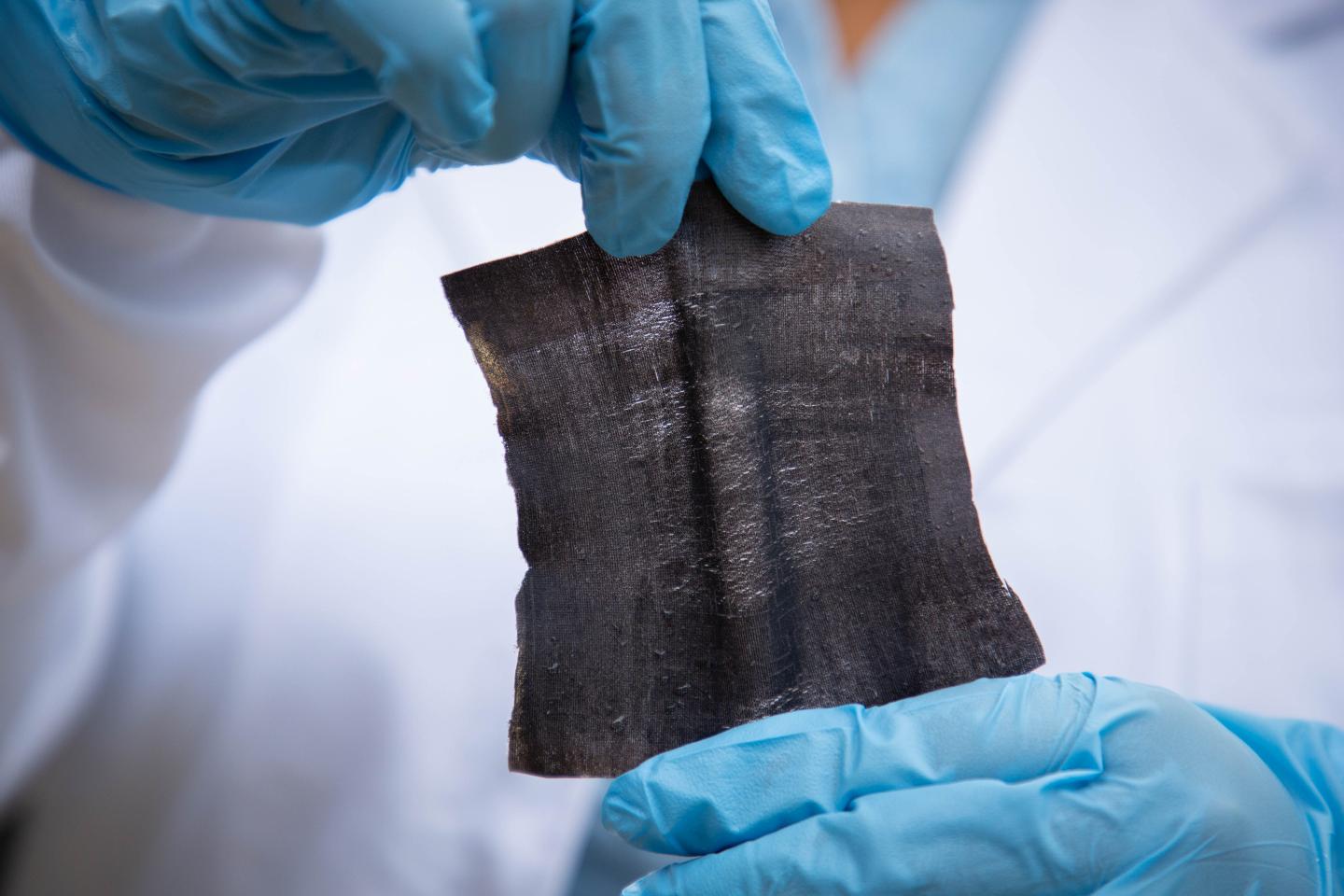 The new technology can produce a 10 x 10 cm smart textile patch in just 3 minutes. Source: RMIT University
A team of scientists from RMIT University in Melbourne, Australia, has devised a new method for producing waterproof smart fabrics in just minutes using new e-textile technology.
Calling the method both cost-efficient and scalable, the team of scientists can manufacture textiles embedded with energy storage devices by laser printing graphene supercapacitors — which are energy storage devices that can be combined with solar and other power sources — directly onto the textiles. In three minutes the team can reportedly manufacture a 10 cm x 10 cm patch of smart textile that is stretchable, waterproof and integrated with energy harvesting technology. By connecting the supercapacitor to a solar cell, the researchers demonstrated proof of concept for a self-powering, washable and efficient fabric that is capable of overcoming the obstacles associated with current energy storage technology.
As demand for wearable devices with built-in sensing capabilities and health monitoring technologies grows — with smart textile wearable devices for everything from monitoring a patient’s vital signs in the healthcare sector to tracking the health and safety of soldiers in the field in the defense sector — so too does the need for robust and reliable energy sources, according to Dr. Litty Thekkakara, a researcher in RMIT's School of Science.
However, current solutions to smart textile energy storage involve stitching batteries into garments or using e-fibers, which can be cumbersome, heavy and likely to experience capacity issues, Dr. Thekkakara added. Likewise, electronic components can reportedly experience short-circuits and mechanical failures when introduced to sweat or moisture from the environment.
The graphene-based supercapacitor is not only fully washable, but it can also store the energy necessary for powering smart fabrics, concluded researchers following mechanical, temperature and washability tests where the textiles remained unchanged. Additionally, the technology could also allow for the real-time storage of renewable energies for e-textiles.
"It also opens the possibility for faster roll-to-roll fabrication, with the use of advanced laser printing based on multifocal fabrication and machine learning techniques," said University of Shanghai professor Min Gu.
The research appears in the journal Scientific Reports.