How do you minimize bubbles in a two-part epoxy system?
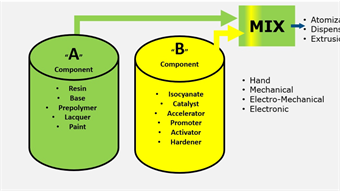
August 12, 2019It is imperative to follow proper mixing techniques to ensure best results when using a two-part epoxy. Mixing should be done slowly to avoid entrapping air. In certain color-coded systems, the visual aid of combining the two colors can make mixing easy. Other systems with low viscosity may also be easier to mix.
Sometimes, even when great care is taken in mixing, air bubbles may still arise. Air bubbles may cause voids or air gaps in the epoxy, which can lead to poor adhesive performance. Consequently, they should be removed. The most effective way to remove air bubbles from an already mixed, unfilled two-part system is by using a centrifuge. High-quality deaeration can be accomplished with a centrifuge at 1,000 to 3,000 rpm for a few minutes. If air bubbles are still visible, it is necessary to repeat the centrifuge cycle and adjust the RPM, if needed. This process may be reiterated until the desired result is obtained.
Another effective way to remove air bubbles is vacuum degassing. The mixed epoxy would be placed in a vacuum chamber that is 5 to 10 times the volume of the epoxy. A vacuum of 29 in of Hg would need to be pulled. For best results, a bumping technique is recommended, which involves a few cycles of pulling and releasing the vacuum.
As previously mentioned, lower viscosity systems may be easier to mix. To lower the viscosity, add heat between 35 C to 40 C in a shallow mixing vessel for a short period of time. However, this solution may not be ideal if the working life of the product is not long, as pre-heating a quick curing epoxy is not recommended.
The bottom line: air bubble removal is an important way to ensure the most suitable end result when working with a two part epoxy system.