Self-assembled micromachines with medical potential
S. Himmelstein | July 26, 2019Micromachines with possible medical applications such as targeted drug delivery within the body or lab-on-a-chip diagnostics have been designed by researchers from Max Planck Institute for Intelligent Systems in 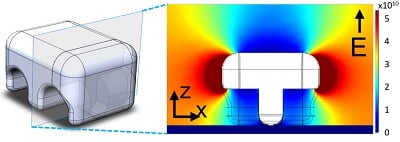 For a microvehicle to be able to mount its own wheels, its chassis must be designed so that a non-uniform field will cause them to be pulled toward the wheel bags. A computer can calculate how the component influences the electric field. Source: Max Planck Institute for Intelligent Systems/Nature Materials 2019 Germany.
The minuscule mechanical components self-assemble into complex, functional devices by means of dielectrophoretic interactions encoded in the 3D shape of the individual parts. An electric field with a specified gradient is used to polarize an electrically insulating plastic frame material coupled with quartz glass or additional plastic components. The shapes of these constituents modify the electric field and govern the assembly of parts, and self-assembly of mobile micromachines with desired configurations can be achieved by pre-programming physical interactions between structural and motor units.
A wheeled micromachine, propelled by a rotating magnetic field, was constructed to demonstrate the technology, as was a micropump for lab-on-a-chip application. The micromachines assembled from magnetic and self-propelled motor parts that exhibit reconfigurable locomotion modes and additional rotational degrees of freedom not available to conventional monolithic microrobots.