Elastomer sheets as shape-shifting actuators
S. Himmelstein | February 06, 2019The motive capabilities of mechanical systems can be enlarged by use of new shape-shifting materials. Linear 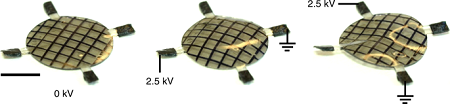 An initially flat thin circular sheet of elastomer (left) morphs into a dome shape (middle) and saddle shape (right), based on which sets of electrodes are addressed, illustrating a simple example of electrode-addressable reconfigurability. The contours of reflected light highlight the local curvatures. Source: Harvard Universityand rotational motions can be augmented by actuation with flat elastomers that transform into 3D shapes.
Harvard University researchers have engineered a method to change the shape of a flat sheet of elastomer using actuation that is fast, reversible and controllable by an applied voltage and reconfigurable to different shapes. Variably shaped carbon nanotube-based electrodes are incorporated between multiple elastomer layers. Application of voltage to the electrodes generates a spatially varying electric field inside the elastomer sheet, producing uneven changes in the material geometry and inducing a morphology transformation into a controllable 3D form. The shape changes are reversible when the applied voltages are removed.
Reconfigurable shape-morphing dielectric elastomers can be used to design new shape-morphing wings and other structures. Existing devices could make use of more sophisticated deformations to function more efficiently, such as optical mirrors and lenses.
The researchers were able to predict the actuation shapes, given the design of the electrode arrangement and applied voltage. The next task will be to achieve the reverse: given a desired actuation shape, determine the design of the electrode and the voltage required to realize it.
A research paper has been published in Nature Communications.