3D Material Has Controllable Shape and Size
By Engineering360 News Desk | March 21, 2016Harvard University researchers have designed a new type of foldable material that can change size, volume and shape; fold flat to withstand the weight of an elephant without breaking; then pop back up ready for the next task.
“We’ve designed a three-dimensional, thin-walled structure that can be used to make foldable and reprogrammable objects of arbitrary architecture, whose shape, volume and stiffness can be dramatically altered and continuously tuned and controlled,” says Johannes Overvelde, graduate student in the lab of Katia Bertoldi, professor of the natural sciences at Harvard's John A. Paulson School of Engineering and Applied Sciences.
The structure is inspired by an origami technique called snapology and is made from extruded cubes with 24 faces and 36 edges. Like origami, the cube can be folded along its edges to change shape. The team demonstrated, both theoretically and experimentally, that the cube can be deformed into many different shapes by folding certain edges, which act like hinges. The team embedded pneumatic actuators into the structure, which can be programmed to deform specific hinges, changing the cube’s shape and size and removing the need for external input.
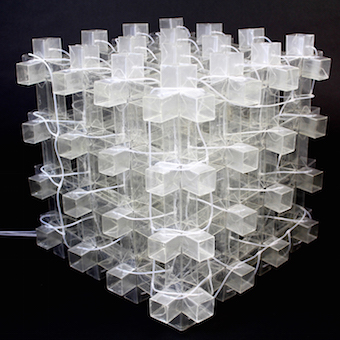 The structure is made from extruded cubes with 24 faces and 36 edges. Image credit: Johannes Overvelde/Harvard SEAS. The team connected 64 of these individual cells to create a 4x4x4 cube that can grow and shrink, change its shape globally, change the orientation of its microstructure and fold completely flat. As the structure changes shape, it also changes stiffness—meaning a material could be made that is very pliable or very stiff using the same design.
“We not only understand how the material deforms, but also have an actuation approach that harnesses this understanding,” says Bertoldi. “We know exactly what we need to actuate in order to get the shape we want.”
The material can be embedded with any kind of actuator, including thermal, dielectric or even water.
“The opportunities to move all of the control systems onboard, combined with new actuation systems already being developed for similar origami-like structures, really opens up the design space for these easily deployable transformable structures," says fellow researcher James Weaver, senior research scientist at Harvard's Wyss Institute for Biologically Inspired Engineering.
“This structural system has fascinating implications for dynamic architecture, including portable shelters, adaptive building facades and retractable roofs,” adds researcher Chuck Hoberman, of the Graduate School of Design. “Whereas current approaches to these applications rely on standard mechanics, this technology offers unique advantages, such as how it integrates surface and structure, its inherent simplicity of manufacture and its ability to fold flat.”