Robust salinity sensor stands up to marine conditions
S. Himmelstein | February 06, 2019Monitoring marine salinity levels provides indicators about the health of ocean ecosystems and biota, but 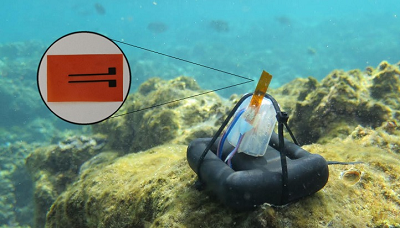 The salinity sensor was tested in the Red Sea. Source: Nathan R. Geraldi, KAUSTacquiring such data is challenging due to the corrosive nature and biofouling activity of dissolved salts. A new lightweight sensor devised at King Abdullah University of Science and Technology (KAUST) in Saudi Arabia overcomes these limitations by use of a flexible polyimide substrate.
Saltier water has a higher electrical conductivity, which can be measured using a pair of electrodes. In marine environments, microorganisms grow on the electrode surface and interfere with sensor operation, causing a decline in the recorded conductance values.
To build a more robust sensor, researchers used a laser beam to write on the polymer sheet and heat specific regions of the material. The resulting conductive strips of graphene form the sensor electrodes.
When tested in the Red Sea at low frequency, biofouling caused the same conductance drop that impacted existing devices. Biofouling exerted no effect on performance when the two-electrode sensor was operated at a high frequency of 1 MHz, and salinity was accurately recorded even after long-term submersion.
The instrument could form the basis of a marine animal monitoring device that records multiple underwater habitat parameters. The laser-induced graphene technique will next be evaluated as a versatile, inexpensive way to create integrated sensor platforms that can monitor temperature, pressure, salinity, pH and magnetic field.