Fault leakage risk for CO2 storage shown to be low
S. Himmelstein | January 27, 2019Carbon capture and storage has been touted as a technology that can capture up to 90% of the carbon dioxide 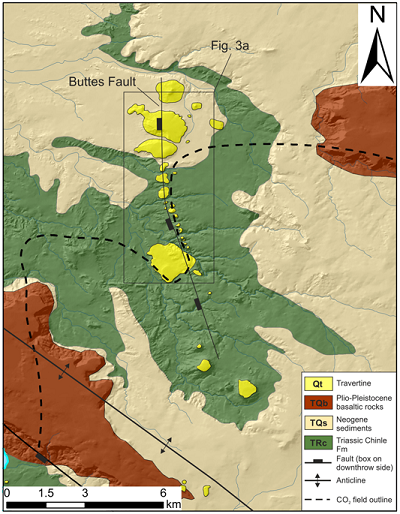 Geological map of the study area along the Buttes Fault in Arizona. Note that the travertine mounds (yellow) align along the fault trace. Source: J. Miocic et al.emissions produced from the use of fossil fuels in electricity generation and industrial processes. This emissions reduction solution entails transport of CO2 via ship or pipeline and permanent storage deep underground in geological formations.
The captured gas can be stored safely for thousands of years by injecting the liquefied gas deep underground into the microscopic pore spaces of common rocks, according to a report from Scottish Carbon Capture & Storage. However, CO2 must be securely retained for 10,000 years with a leakage rate below 0.01% per year of the total amount injected to be an effective climate change mitigation option. Release via leakage through geological faults is a potential high impact risk to CO2 storage integrity.
To assess such risk, researchers studied a natural CO2 repository in Arizona where gas migrates through geological faults to the surface. Uranium-thorium dating of surface travertine deposits allowed analysis of vertical gas leakage along a known fault, revealing that small volumes of carbon dioxide escaped each year. The time-averaged leakage equates to a linear rate of less than 0.01% per year, well within the safe levels needed for effective storage.
This determination could serve to increase the number of sites worldwide that are deemed suitable to securely store CO2 for hundreds of thousands of years. Scientists from the University of Edinburgh, University of Glasgow, University of Freiburg (Germany) and University of Heidelberg (Germany) contributed to the research, which is published in Scientific Reports.