Anemia Screening? There’s an App for That
S. Himmelstein | December 05, 2018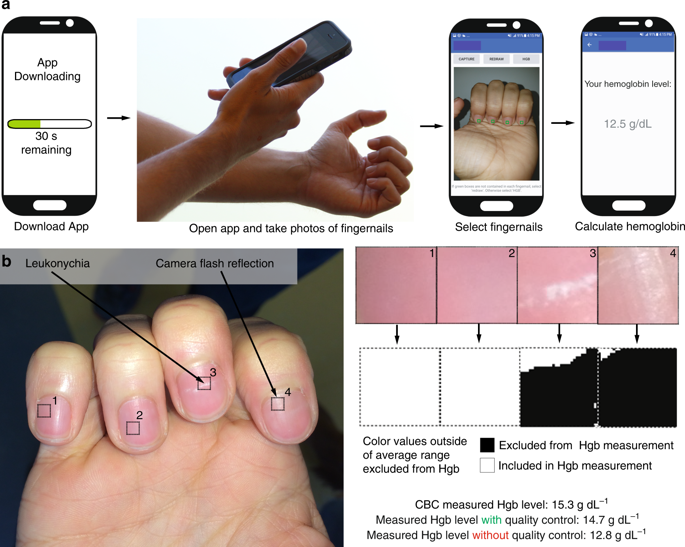 A patient downloads the app onto their smartphone, opens the app, obtains a smartphone photo of his/her fingernail beds, and without the need for any blood sampling or additional smartphone attachments quantitatively measures blood hemoglobin levels. Source: Mannino et al Nature Communications 2018
Why submit to a blood test to detect anemia when a smartphone app can do the same thing noninvasively? The new app uses smartphone photos of a user’s fingernails to accurately measure how much hemoglobin is in his or her blood with accuracy on par with point-of-care protocols.
The developers caution that the app should be used for screening, not clinical diagnosis. The technology could be used by anyone at any time and could be especially appropriate for pregnant women, women with abnormal menstrual bleeding or athletes. The simple technique could also prove useful in developing countries.
The researchers analyzed fingernail photos and correlated the color of fingernail beds with hemoglobin levels measured by complete blood counts (CBC) in 337 people. An algorithm for converting fingernail color to blood hemoglobin level was developed with 237 of these subjects and then tested on 100.
A single smartphone image, without personalized calibration, can measure hemoglobin level with an accuracy of 2.4 grams/deciliter with a sensitivity of up to 97%. Personalized calibration, tested on four patients over the course of several weeks, improves accuracy to 0.92 grams/deciliter, which is comparable with point-of-care blood-based hemoglobin tests. Normal values are 13.5 to 17.5 grams/deciliter for males and 12.0 to 15.5 grams/deciliter for females.
Reliance on fingernail beds, which do not contain melanin, means the test can be valid for people with a variety of skin tones, as accuracy is consistent for dark or light skin tones. The app uses image metadata to correct for background brightness and can be adapted to phones from multiple manufacturers.
The app, which is projected to be available commercially for public download as soon as spring of 2019, could facilitate self-management by patients with chronic anemia, allowing them to monitor their disease and adjust therapies.
Researchers from Georgia Institute of Technology and Emory University contributed to this study, which is published in Nature Communications.