AI Program Used to Identify Galaxies
Siobhan Treacy | October 31, 2018Researchers from the University of Western Australia have created an artificial intelligence (AI) program that can identify galaxies in deep space. The program grew from a system that was used to identify faces on Facebook.
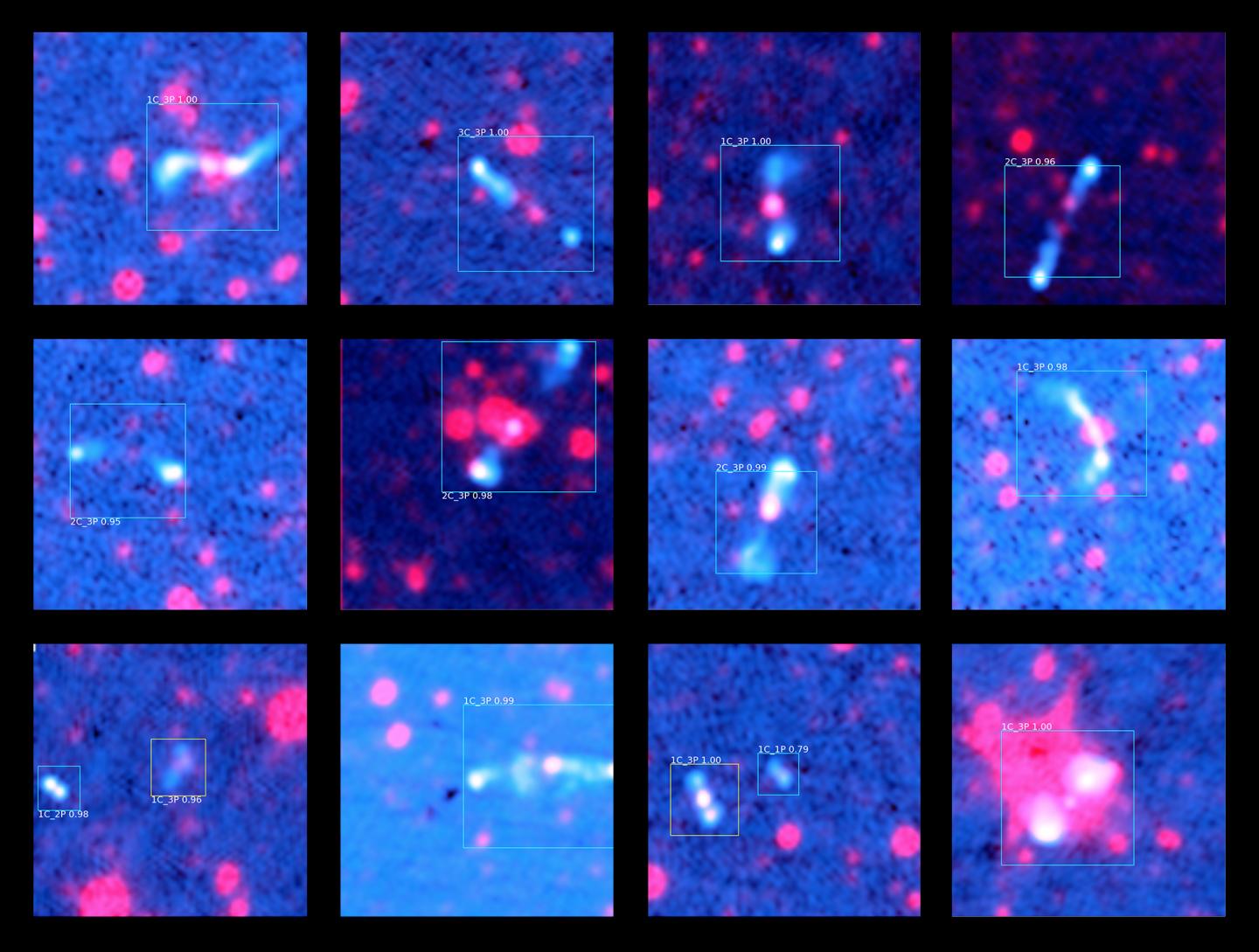 Fourteen radio galaxy predictions ClaRAN made during its scan of radio and infrared data. All predictions were made with a high 'confidence' level, shown as the number above the detection box. (Source: Dr. Chen Wu and Dr. Ivy Wong, ICRAR/UWA)
The AI bot is named ClaRAN. ClaRAN scans images taken by radio telescopes and searches for radio galaxies that emit radio jets from supermassive black holes at the center.
"These supermassive black holes occasionally burp out jets that can be seen with a radio telescope," said astronomer Dr. Ivy Wong, "Over time, the jets can stretch a long way from their host galaxies, making it difficult for traditional computer programs to figure out where the galaxy is. That's what we're trying to teach ClaRAN to do."
ClaRAN started with an open source version of Microsoft and Facebook’s object detection software. The team overhauled this program and trained it to recognize galaxies instead of faces.
An upcoming EMU (evolutionary map of the universe) survey using Western Australia-based Australian Square Kilometer Array Pathfinder (ASRAP) Telescope is expected to observe 70 million galaxies. The team wants to use their AI software to identify individual galaxies.
Traditional computer algorithms could correctly identify 90 percent of the galaxies out of the 70 million. But the team doesn’t want to leave a galaxy unidentified.
"That still leaves 10 percent or seven million 'difficult' galaxies that have to be eyeballed by a human due to the complexity of their extended structures," Dr Wong said, "If ClaRAN reduces the number of sources that require visual classification down to one percent, this means more time for our citizen scientists to spend looking at new types of galaxies.”
A catalog created by the Radio Galaxy Zoo volunteers was used to train ClaRAN to find the origins of a black hole jet. This system is an example of the new “Programming 2.0.”
"All you do is set up a huge neural network, give it a ton of data, and let it figure out how to adjust its internal connections in order to generate the expected outcome," big data specialist Dr. Chen Wu said. “The new generation of programmers spend 99 percent of their time crafting the best quality data sets and then train the AI algorithms to optimize the rest. This is the future of programming."
"If we can start implementing these more advanced methods for our next generation surveys, we can maximize the science from them," said Dr. Wong, "There's no point using 40-year-old methods on brand new data because we're trying to probe further into the Universe than ever before."
The paper on this new system was published in the Monthly Notices of the Royal Astronomical Society. The system is open source and available on GitHub.