
Efficient CO2 Conversion with New Electrochemical Cells
S. Himmelstein | October 31, 2018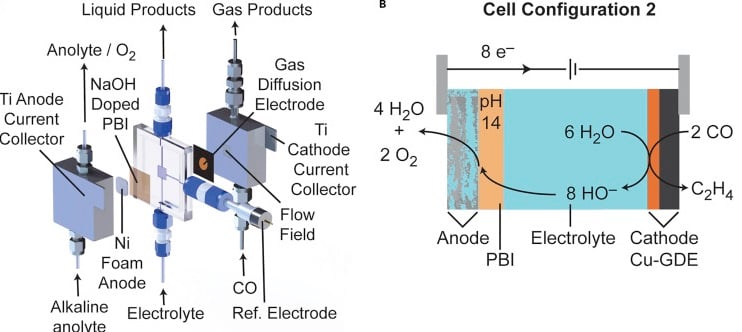 Schematic of the electrochemical cell. Source: Stanford University
While an attractive option for addressing climate change, carbon dioxide capture from emission sources is an expensive process that harvests a product with little commercial value. Value can be added to captured CO2 by using electrolysis to convert it into more desirable products such as ethylene for polymer production or acetate as a reagent for chemical synthesis.
Previously developed electrochemical cells required an excess of carbon monoxide to achieve a high electrolysis rate, which results in diluted products that must be concentrated and purified at the cost of increased energy consumption. A new approach developed at Stanford University counters these inefficiencies with a modified design that produces a concentrated stream of ethylene gas and a sodium acetate solution 1,000 times more concentrated than products obtained with previous cells.
The cell combines a gas diffusion electrode (GDE) with a flow field to improve CO delivery to the electrode surface and the removal of products. The design also eliminates the need for an electrolyte solution in the cell by interfacing the GDE directly with a membrane. Both ethylene and concentrated acetate solution are produced at the electrode and swept out of the cell in a single vapor stream.
The research is published in Joule.


Something doesn't look right to me.
So which is it, a process to deal with CO2 or CO?