Solid Oxide Fuel Cell Keeps Its Cool
S. Himmelstein | October 31, 2018Fuel cell research has tended to focus on systems that either operate at high temperatures for grid-scale applications or at low temperatures for vehicle technologies. There is a critical need for intermediate-temperature fuel cells that provide low-cost, distributed generation both at the system and device levels.
A solid oxide fuel cell that runs on methane instead of higher-cost hydrogen, at a temperature of 500° C, is 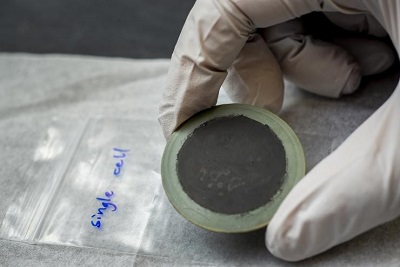 The new fuel cell is practical to run at cooler temperatures. Source: Georgia Institute of Technology/Christopher Mooreunder development by researchers from the University of Kansas and Georgia Institute of Technology. The design eliminates the need for a steam reformer, which is normally required to convert methane and water into hydrogen fuel. Instead, the fuel cell converts methane to hydrogen by use of a new catalyst made with cerium, nickel and ruthenium.
When methane and water molecules come into contact with the catalyst and heat, nickel chemically cleaves the methane molecule as ruthenium does the same with water. The resulting hydrogen and carbon monoxide react with additional catalyst layers that make up the barium zirconate anode, generating positively charged ions that travel on to the cathode. The device’s water supply is replenished in the last reaction phase, which forms water that cycles back to react with the methane.
The fuel cell achieved a peak power density of 0.37 W/cm2, and is envisioned as a future contributor to distributed generation systems for commercial and residential application.