
Proof That Earth is 'Hard Core'
S. Himmelstein | October 22, 2018Long theorized to have a solid center, researchers have documented proof that the Earth’s inner core is indeed solid. The evidence lies in the detection of shear, or “J” waves, which are only transmitted through solid 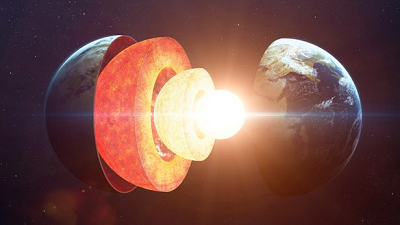 The inner core is solid but somewhat squishy. Source: Shad.off/Depositphotosobjects.
Direct detection of these waves has been impossible because of their small amplitudes, prompting Australian National University researchers to apply a correlation wavefield method, previously used to analyze earthquake signals and to measure Antarctic ice thickness, to the problem. The approach zones in on similarities between signals at two receivers after a major earthquake.
A cross-correlation of similarity is generated by analyzing data from receiver pairs to extract the similarity between seismograms, resulting in a global correlogram. The data demonstrated the occurrence of J waves and enable inference of shear wave speed in the inner core.
The surprising finding: the inner core is solid, but relatively soft. Shear-wave speeds and shear moduli of 3.42 ± 0.02 km per second and 149.0 ± 1.6 gigapascals (GPa) near the inner core boundary and 3.58 ± 0.02 km per second and 167.4 ± 1.6 GPa in Earth’s center were observed.



This is quite a trick, analyzing shear waves through the solid core, which is surrounded by the liquid core that doesn't transmit shear waves.
The only way I can see this being done is if the shear waves are generated within the solid core when compression waves in the liquid core strike the interface at an angle. These shear waves would have to travel through the solid core and the inverse process would have to generate compression waves which could then propagate through the liquid core and eventually reach the surface of the earth.
The resulting amplitude has to be very low.
"Oblique Incidence
When a P-wave is obliquely incident, there is a reflected P wave, and the transmitted ray is refracted in accord with Snell's Law.
In addition, some of the compressional energy is converted into shear energy, and a reflected and refracted S-wave is generated too."
https://www.ucl.ac.u
In reply to #1
I was just going to say that, Oh well!
Bazzer
In reply to #1
Seems like there are an awful lot of assumptions about the accuracy of the science to come to the conclusion being put forward.