Life Expectancy Trends Projected to 2040
S. Himmelstein | October 17, 2018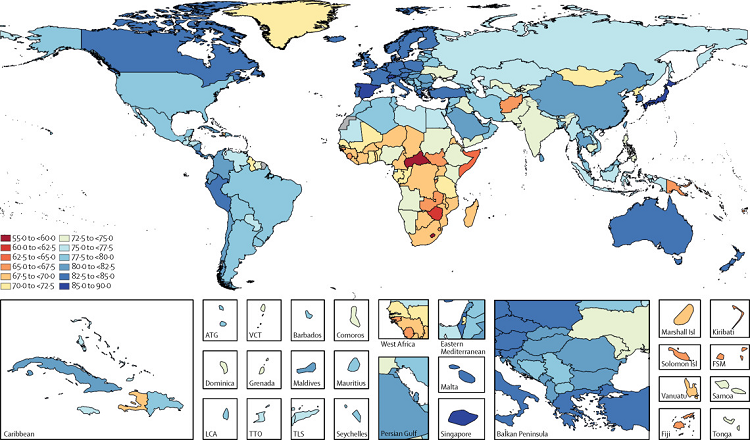 Map of life expectancy for both sexes in 2040 based on the reference forecast. Source: University of Washington
How healthy will the world be in 2040? If current trends continue, the answer is better off than we are today: life expectancy will be, on average, 4.4 years higher for both women and men worldwide by 2040. A global dataset was used to model and analyze relationships between risk factors and health outcomes for 79 independent drivers of health.
China, with an average life expectancy of 76.3 years in 2016, ranked 68th among 195 nations. If recent health trends continue it could rise to a rank of 39th in 2040 with an average life expectancy of 81.9 years, an increase of 5.6 years.
The U.S. ranked 43rd in 2016 with an average lifespan of 78.7 years. In 2040, life expectancy is forecast to increase only 1.1 years to 79.8, but dropping in rank to 64th. By comparison, the U.K. had a lifespan of 80.8 years in 2016 and is expected to increase to 83.3, raising its rank from 26th to 23rd in 2040.
Other high-income nations projected to drop substantially in their life expectancy rankings include:
•Canada from 17th to 27th
•Norway from 12th to 20th;
•Taiwan (Province of China) from 35th to 42nd
•Belgium from 21st to 28th
•Netherlands from 15th to 21st
Other nations expected in 2040 to increase in their life expectancy rankings:
•Syria is expected to rise most in rank globally – from 137th in 2016 to 80th in 2040
•Nigeria from 157th to 123rd
•Indonesia from 117th to 100th
A significant increase in deaths is forecast from non-communicable diseases, including diabetes, chronic obstructive pulmonary disease, chronic kidney disease, lung cancer and worsening health outcomes linked to obesity. The top five health drivers that explain most of the future trajectory for premature mortality are high blood pressure, high body mass index, high blood sugar, tobacco use and alcohol use.
The University of Washington research is published in The Lancet.