
Team Uses "Robomussels" to Check Mussel Temperatures
Marie Donlon | October 04, 2018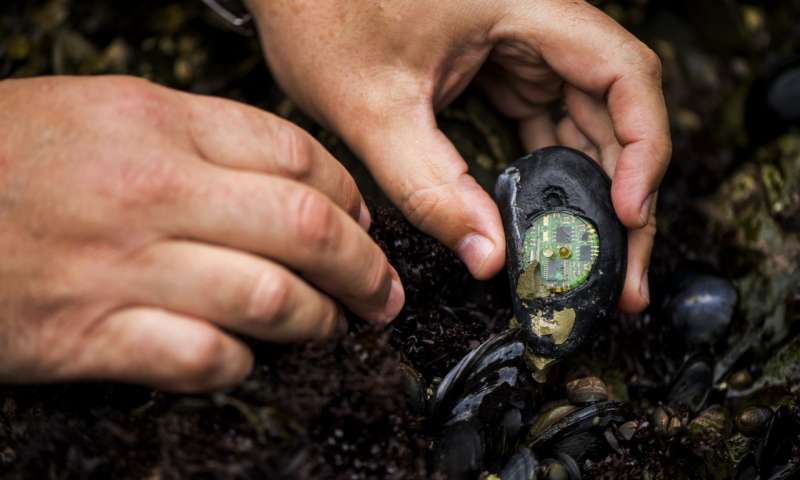 Brian Helmuth, professor of environmental science and public policy, and Francis Choi, senior lab technician, work in the intertidal zone by the Marine Science Center in Nahant, Massachusetts. Source: Adam Glanzman/Northeastern University
As temperatures rise due to climate change, mussels tucked away in their intertidal beds face temperatures reaching close to their lethal limit in certain regions of the world. As such, researchers are attempting to determine what that temperature threshold is by examining refugia, otherwise known as geographic regions less susceptible to climate change where animals like mussels, incapable of relocating, have a higher chance of survival.
"If we have a big heat wave that bakes everything off the shore, there may be animals that survive in some of these refugia," said Brian Helmuth, a Northeastern University professor of marine and environmental sciences. Survivors, according to Helmuth, can then begin to repopulate surrounding areas.
Considering that temperatures continue to rise, investigators wondered where a mussel refugium might exist and to answer that, researchers needed to track the internal temperatures of mussels.
Although the internal temperature of mussel bodies is linked to the temperature of their environments, this, according to researchers, is an insufficient measure of body temperature.
"Air temperature as a proxy is not a good measurement of what body temperatures are for intertidal organisms," said Francis Choi, who manages the Helmuth Lab.
Instead, Helmuth has developed an accurate gauge for measuring body temperature for just this purpose called the “robomussel.” The robomussel looks and feels like a real mussel, featuring all of the same thermal qualities. Mimicking the shape, size and color of real mussels, the epoxy device can absorb and release heat in much the same way as a real mussel.
Calling the robomussels much more accurate, Helmuth explained. "We can get really surprisingly close to what the temperature of the animal is," Helmuth said, "usually within about two degrees."
Using the robomussels since they were first developed in 1998, Helmuth believes that they are on the path to finding regions along the world’s coastlines safe enough for mussels to exist.



you will learn to set alarm in windows 10 operating system in easy steps It's great to get the way to the alarm app Windows 10, this is a full update app for use by many web users.