Sticking the Landing…on Mars
Peter Brown | September 26, 2018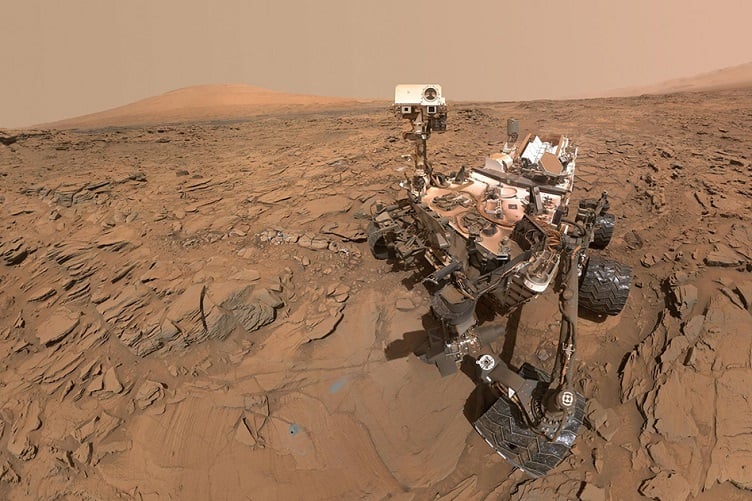 Rovers on Mars could find easier paths to their destinations through a new software program. Source: NASA
When planning a mission to Mars, NASA and its team of scientists and engineers spend several years weighing a mission’s objectives, including a landing site for spacecraft.
This is due to the science team wanting to explore certain geological sites for signs or water, life and habitability. But they may find these sites are too steep for a spacecraft to land safely, or the site doesn’t have enough sunlight to power solar panels.
To make this process easier, researchers at MIT have developed a software tool for computer-aided discovery which automatically produces maps of favorable landing sites using data on Mars’s geology and terrain, as well as scientists’ mission parameters.
The program can lay out possible paths a rover could take from a given landing site to certain geological features. For example, if a scientist wants the rover to explore sedimentary rock, the program would explore paths to any such nearby structures and calculate the time it takes to reach these locations. The software includes an algorithm that can map out routes to avoid certain obstacles that may slow rovers down and chart out the probabilities of hitting certain types of geological structures in a landing area.
“This is never going to replace the actual committee, but it can make things much more efficient, because you can play with different scenarios while you’re talking,” said Victor Pankratius, principal research scientist in MIT’s Kavli Institute for Astrophysics and Space Research.
When testing the program based on a conceptual mission for NASA’s Mars 2020 rover—which is engineered to land in horizontal, dust-free and even-terrain areas, and aims to explore ancient, potentially habitable sites with magmatic outcrops—the software identified many landing sites for the rover that have been considered in the past and highlighted other promising landing sites that were rarely proposed.
Researchers said the program could also explore engineering requirements for future generations of Mars rovers, potentially allowing them to land on steeper curves or drive faster after landing.
“It’s more difficult for a rover to drive through dust, so it’ll go at a slower pace, and dust isn’t necessarily everywhere, just in patches,” said Guillaume Rongier, in MIT’s Department of Earth, Atmospheric and Planetary Sciences. “The algorithm will consider such obstacles when mapping out the fastest traverse paths.”
In the future, the software could be embedded into autonomous rovers that don’t require humans to continuously operate the vehicles from Earth.
“One day, if we have fully autonomous rovers, they can factor in all these things to know where they can go, and be able to adapt to unforeseen situations,” Pankratius said. “You want autonomy, otherwise it can take a long time to communicate back and forth when you have to make critical decisions quickly.”
The full research can be found in the journal Earth and Space Science.