How to Build a Research Base on Mars
S. Himmelstein | September 13, 2018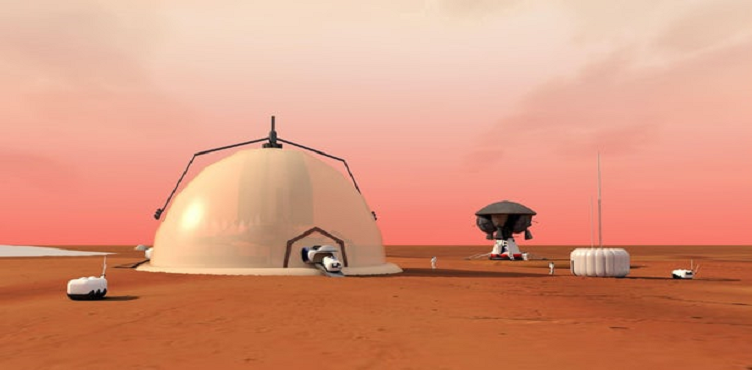 Artist’s rendering of a research base on Mars. Source: EPFL
As the logistics of getting a mission to Mars off the ground is being tackled by NASA, Swiss researchers are developing a roadmap for establishing a long-term, self-sustaining research base on the planet.
École Polytechnique Fédérale de Lausanne (EPFL) engineers are planning habitation and technology requirements for a six-person crew arriving at Mars’ north pole for a nine-month mission during the polar summer. Landing at the start of this Martian season would enable crews to operate and return during the 288 days of continuous light. Polar-layered deposits of ice and dust were selected as optimal colonization sites, as these regions host natural resources that might be exploited.
The presence of ice at the poles implies that water, oxygen and nitrogen could be produced at the research base. Bricks, plastics and hydrogen and methanol fuels could be based on available atmospheric carbon dioxide and soil-derived aluminum and iron to enhance the long-term self-sufficiency of the facility.
The first step would be to deploy robots to install minimal living accommodations for the crew and to assess the availability of local natural resources. The crew would then arrive with freeze-dried food, batteries and other essential supplies in an approach intended to minimize space shuttle payloads, though each landing would need to handle 110 tons of cargo.
Three robot-constructed modules are proposed to comprise the base, starting with a 12.5-m-high and 5-m- diameter central core to encompass living space and supply storage. This component is encircled by three capsules designed as airlocks between the core and its exterior, and the entire space is encompassed by a dome. Polyethylene fiber encased in a 3-m-thick ice layer forms this igloo-like covering, which would also provide extra living space and internal pressure regulation.
A reusable orbital crane powered by Mars-made fuel is also envisioned to offload supplies from space shuttles to the planet’s surface. Its docking system would be similar to that used on the International Space Station, but a novel design would place the engines above the crane’s center of gravity.
Whether these plans and designs are realized in a mission to Mars, the researchers noted that some of the robotic technologies outlined could be of value closer to home.