Space: The Final Frontier for Graphene
Tony Pallone | August 20, 2018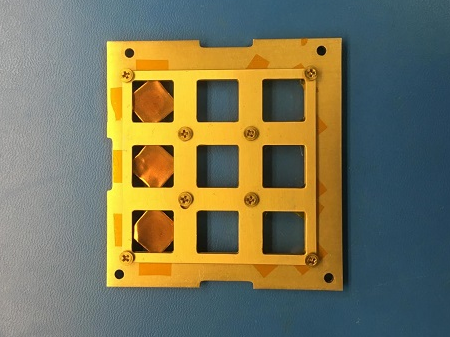 A substrate coated with a single layer of graphene was placed in the payload enclosure of the 'Wayfinder-Mini' CubeSat. Source: Boreal Space
Graphene has already proved its usefulness on Earth — so why not explore its potential for use in space?
Scientists at the National University of Singapore (NUS) have teamed up with U.S.-based aerospace company Boreal Space to test the properties of the two-dimensional carbon material after it has been launched into the stratosphere.
“Space is the final frontier for graphene research,” said project leader Professor Antonio Castro Neto, who serves as director for the NUS Centre for Advanced Two-Dimensional Materials (CA2DM).
"To move a spacecraft over long distances in space, huge accelerations and speeds which are only possible with very low mass equipment are needed. Graphene is the ideal material…it is among the lightest, yet strongest, functional materials we have,” Castro Neto added. “The high electronic performance of graphene (also) makes it a prime candidate to handle the lack of oxygen and low temperatures in space."
To put graphene to the test, scientists coated a substrate with a single graphene layer that was about 0.5 nanometers thick — over 200 times thinner than a strand of human hair. The sample was assembled within a Boreal Space 'Wayfinder-Mini' CubeSat, placed in the payload enclosure of the sounding rocket and launched into suborbital environment on the morning of June 30, 2018.
During the 71-second journey, the material was subject to conditions like rapid acceleration, vibration, acoustic shock, strong pressure and a wide range in temperature fluctuations. The team is now in the process of carrying out tests to assess whether structural properties and stability were affected during the launch and landing.
"If this research collaboration is able to demonstrate that graphene maintains its various properties and features after being launched into suborbital environment, it will open up exciting new opportunities for graphene to be incorporated into technologies suitable for outer space and aerospace missions," said Castro Neto.