Clot-Busting Nanogel Offers Fast Response to Heart Attacks
S. Himmelstein | August 06, 2018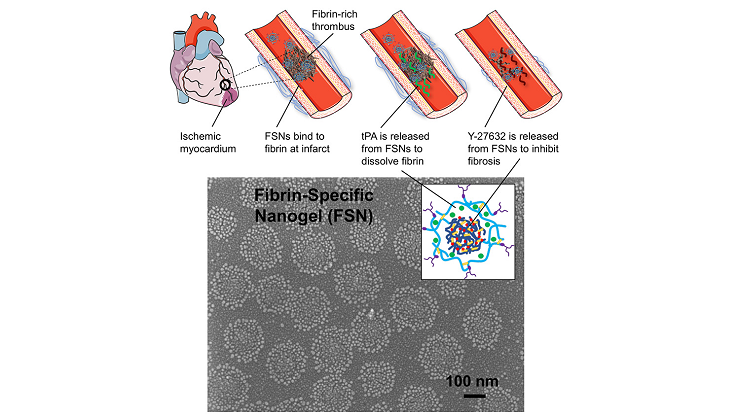 The nanospheres target a clot and deliver a cocktail of two drugs. Source: North Carolina State University
Myocardial infarctions, more commonly known as heart attacks, occur when a clot blocks a blood vessel in the heart. Treatment typically requires surgical intervention to introduce a catheter to the blood vessel, facilitating the removal or destruction of the clot. The removal of a clot poses additional risk in the form of reperfusion injury as blood rushes back into vessels.
A new nanogel-based drug delivery system may offer a faster, non-surgical remedial option. Researchers from North Carolina State University and the University of North Carolina at Chapel Hill designed 250 nm-diameter nanogel spheres to target a clot and deliver a cocktail of two drugs: tPA and Y-27632. Each porous nanogel is coated with proteins that bind specifically to fibrin, a component common to all blood clots, so that the spheres adhere to any clot encountered.
The drugs are layered inside the nanosphere, with the tPA encasing the Y-27632. This arrangement allows the tPA to be released first to break down fibrin and dissolve the clot. The Y-27632 is then delivered to limit the damage caused by reperfusion injury by reducing the rigidity of cells in the area that contribute to scarring.
In in vitro testing, the researchers found that the targeted tPA/Y-27632 cocktail dissolved clots in a matter of minutes. Testing confirmed that the targeted nanogels do not migrate to the lungs, liver or other tissues, and because of their small size can travel to blood vessels too small to reach with catheters.
The technique also limited scarring and preserved heart function in laboratory rats after heart attack better than targeted tPA or Y-27632 by themselves. The researchers expect this system to work more quickly than surgical interventions, which require time to prep the patient and get the catheter in place.