
Tiki Torch Soot Serves as Surrogate for Diesel Engine Soot
S. Himmelstein | July 30, 2018University of Notre Dame researchers are using an unusual tool to mimic the soot oxidation process in a diesel engine. Tiki torches, more commonly found in service at backyard barbecues, were discovered to offer a simple way to simulate real-world driving conditions, including the continuous flow of soot as it passes through a diesel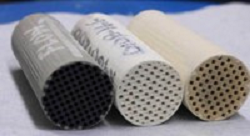 Sample cores from particulate filters used in testing. Source: University of Notre Dame particulate filter.
For diesel engine vehicles, the U.S. Environmental Protection Agency requires both soot and nitrogen oxides be kept below certain levels, but challenges remain to reducing those emissions economically without sacrificing performance. When the engine’s operating conditions are adjusted to emit low levels of NOx, soot levels increase, and vice versa.
A standard diesel particulate filter is a ceramic cylinder with a honeycomb-style structure and porous walls. Every other channel — or opening — of the filter is closed off. As exhaust enters the filter, soot collects along the interior walls as cleaned exhaust passes through.
To burn off soot buildup along the filter walls, exhaust temperatures need to reach 600 degrees Celsius (1,112 degrees Fahrenheit). In some cases, fuel is used to heat up the filter and burn off the soot in an active regeneration process, which also undermines a vehicle’s fuel mileage and requires substantial noble metal usage.
The researchers constructed a sophisticated reactor equipped with soot generator and backpressure sensors, allowing control of conditions including oxygen rates, air-to-fuel ratios and soot production per hour. With Tiki torches providing the soot buildup needed for testing, the team will continue to optimize an inexpensive glass coating designed to deliver a potassium catalyst over 150,000 miles of driving. This passive regeneration approach might also be tailored to reduce NOx.
The research is published in the journal Catalysts.




Next we will need to add catalytic converters to our Tiki torches!!