Fuel-Saving Diesel Soot Sensor Advances
Engineering360 News Desk | December 23, 2015A wireless sensor that saves fuel by measuring soot and ash buildup in diesel filters and determining when they need to be cleaned could be adopted by vehicle manufacturers in the next few years. Massachusetts Institute of Technology spinoff Filter Sensing Technologies (FST) invented the sensor several years ago and tested the technology in a two-year study with New York City garbage trucks. The sensors cut the frequency and duration of "filter regeneration" by half, producing a 1-2 percent fuel savings.
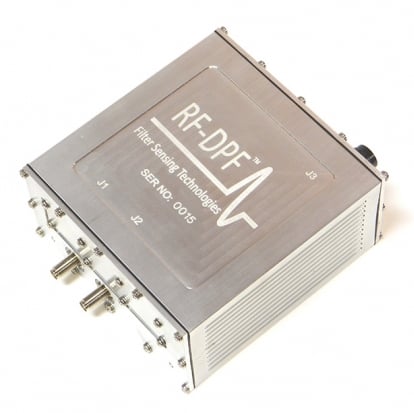 The sensor tracks radio signals coming through a vehicle's filters. Image credit: CTS Corp. Now, with its recent acquisition by CTS Corp., a manufacturer of vehicle electronics and sensors, FST is set to scale up manufacturing of its sensors for diesel engines, which must meet increasingly strict emissions limits. “The industry dynamics are such that it is challenging for a small company to scale and meet original equipment manufacturers' (OEMs') requirements of quality and volume. This means additional resources for scaling up and manufacturing” to meet those requirements, says FST co-founder and sensor co-inventor Alex Sappok, now director of RF sensors for CTS.
Currently, the sensors are being piloted with OEMs across the United States, Europe and Japan for commercial vehicles as well as for construction and agricultural equipment.
The sensors are basically metal antennas mounted inside the exhaust system of vehicles that use diesel particulate filters (DPFs). In 2007, the U.S. Environmental Protection Agency introduced emissions limits for diesel engines, resulting in the widespread use of these large ceramic filters, which capture more than 95 percent of the soot and other particles emitted from diesel engines.
A downside to DPFs, however, is that they can become saturated frequently—sometimes every eight hours, depending on engine use—and must be cleaned. With diesel trucks, for instance, the engine “regenerates” the filter by using fuel to heat the exhaust to high temperatures and burn the soot, like a self-cleaning oven. Conventional technologies use pressure-drop measurements and predictive models to estimate buildup. If the estimates are off, soot and ash can exceed the filter’s limit, impacting the pressure-drop response, service life and fuel consumption.
With little way to accurately measure buildup in real time, OEMs generally program a diesel truck’s control system to regenerate the filter more frequently than necessary, regardless of actual contamination, Sappok says. “Trucks are burning a lot more fuel than they need in order to heat up and clean off this filter,” he says.
The sensors transmit a signal similar to those used for cell phones, through part of the vehicle’s emissions-control system. As soot and ash accumulate in the filter, the signal strength decreases; the weaker the signal, the more buildup. “It’s the same concept as going through a tunnel on your phone and losing a signal,” Sappok says. These data are received by the onboard engine-control system, so the engine initiates self-cleaning only when it is needed and ends it when the filter is cleaned, saving fuel.
Since its acquisition, FST is now the company's Boston Innovation Office, where the startup team will further develop and explore other applications for the sensors. The sensors could be available to the automotive industry within a few years.