Researchers Create a Centimeter-accurate GPS System
Engineering360 News Desk | May 06, 2015Researchers at the Cockrell School of Engineering at The University of Texas in Austin have developed a GPS-based positioning system with an accuracy measured in centimeters. The system could enhance virtual reality headsets, cell phones and other technologies by offering a more precise global positioning and orientation system.
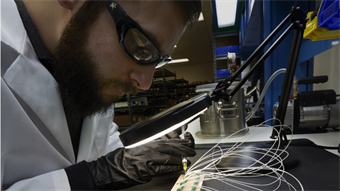
 Ken Pesyna and Andrew Kerns, graduate students behind Radiosense. Source: University of TexasThe researchers claim their new system that is coupled with a smartphone camera, could allow unmanned aerial vehicles to deliver packages to a specific spot on a consumer's back porch, allow for collision avoidance technologies on cars and allow virtual reality (VR) headsets to be used outdoors.
"Imagine games where, rather than sit in front of a monitor and play, you are in your backyard actually running around with other players," says Todd Humphreys, assistant professor in the Department of Aerospace Engineering and Engineering Mechanics and lead researcher. "To be able to do this type of outdoor, multiplayer virtual reality game, you need highly accurate position and orientation that is tied to a global reference frame."
The system built by Humphreys and his team will minimize location errors from the size of a large car to the size of a nickel—more than 100 times increase in accuracy.
The breakthrough is a software-defined GPS receiver that can extract centimeter accuracies from the antennas found in mobile devices—such precise measurements were not previously possible. The researchers anticipate that their software's ability to leverage low-cost antennas will reduce the overall cost of centimeter accuracy, making it economically feasible for mobile devices. They reportedly are working with Samsung—which is helping to finance the research—to build a snap-on accessory that will offer smartphones, virtual reality headsets and tablets their precise location and orientation.
Humphreys and his students recently co-founded a startup, Radiosense, to further develop this technology. The researchers believe that their invention can significantly change people's daily lives, including transportation.