Discover a Simulation Database Dedicated to Planetary Plasma Environments
S. Himmelstein | June 16, 2018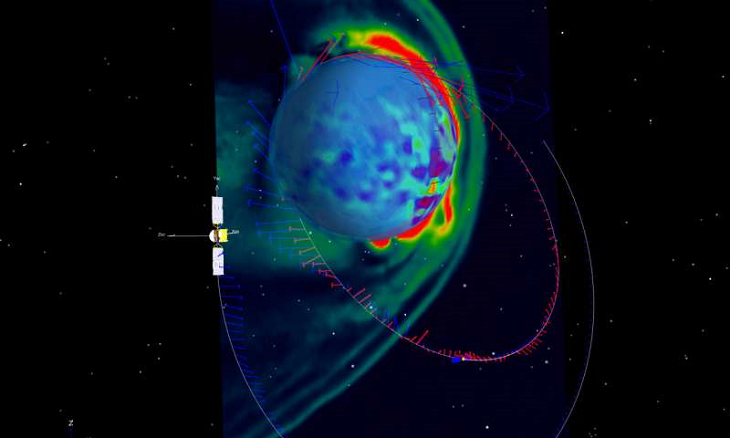 Visualization of the Martian environment showing the Mars Express orbit and magnetic field observations (red arrows) sampled by the MAVEN spacecraft along its orbit. The view also includes the simulated map of the magnetic field magnitude in the Mars-centered XZ plane perpendicular to the planet's orbit, where the X axis points toward the Sun, and the simulated magnetic field vectors along the Mars Express and MAVEN spacecraft orbits (blue vectors). Source: CNES/IRAP/GFI informatique; LatHyS; 3DView A new database of plasma simulations is combined with observational data and visualization tools, providing planetary scientists with a new way to explore some of the Solar System's most interesting plasma environments. An international collaboration has resulted in the Latmos Hybrid Simulation (LatHyS) database, which includes a number of simulation results of plasma — the mixture of charged particles that permeates interplanetary space — at selected planets or planetary bodies. The simulations are based on advanced numerical models that consider a number of complex physical and chemical processes in the upper atmospheres of celestial objects, their interaction with the solar wind and response to solar radiation.
The database gives access to simulated plasma data, including electric and magnetic fields, density, temperature and plasma bulk speed. LatHyS, together with a suite of data analysis and visualization tools, allows researchers to combine data from various spacecraft with simulation results and produce 3D images depicting how the solar wind interacts with planetary plasma, and much more.
The researchers used observational data from the European Space Agency’s Mars Express, a mission that has been exploring the planet since 2003, probing its plasma environment in detail. Data were also included from a second Mars orbiter equipped with a plasma instrument: NASA's Mars Atmosphere and Volatile Evolution Mission (MAVEN), which arrived at Mars in 2014 and has been studying the planet's plasma environment and its interaction with the solar wind in collaboration with Mars Express.
The data from MAVEN and Mars Express were combined and compared with the LatHyS simulation results. By combining the simulations with observational data and the orbits of the two spacecraft using 3DView — a 3D visualization tool developed by the French Plasma Physics Data Center — the team could analyze how the solar wind interacts with the Mars upper atmosphere.
Researchers from LATMOS/IPSL, UVSQ Université Paris-Saclay, UPMC University Paris CNRS, ONERA, Université de Toulouse, University of Virginia, Noveltis, GFI, Austrian Academy of Science, University of Colorado-Boulder, University of IRF, SINP-MSU, IWF and CNES contributed to this development.