
A future for fusion in space missions
S. Himmelstein | September 07, 2023What is claimed to be the largest practical nuclear fusion rocket engine ever built is now under construction by U.K.-based Space propulsion company Pulsar Fusion. The propulsion system under development can significantly cut transit time to Mars and other planets with exhaust speeds in excess of 500,000 miles per hour.
A new direct fusion drive (DFD) rocket engine could provide both thrust and electrical power for spaceships and produce thrust without the need for an intermediary, electricity-producing step. In a DFD system, the fusion reactor generates energy, creating a plasma of electrically charged particles. Those energetic particles are converted to thrust using a rotating magnetic field. The rocket engine is expected to reach several hundred million degrees, creating temperatures hotter than the Sun. DFD drives are ideal for space travel since the energy produced is clean, virtually limitless and the drive is relatively compact.
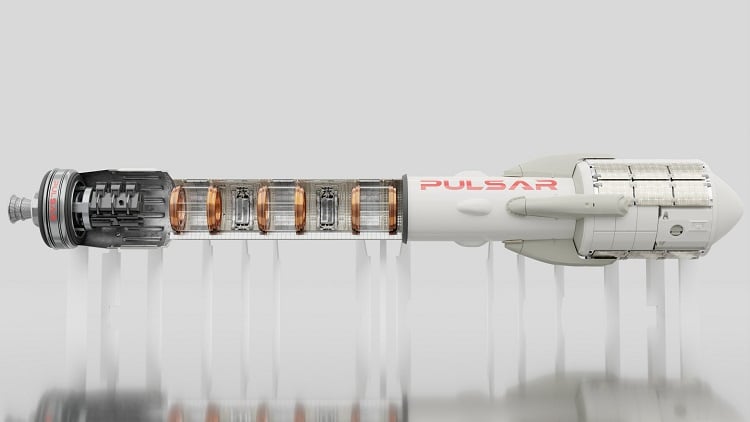 A hyper speed nuclear fusion rocket engine is under development. Source: Pulsar Fusion
Confining the super-hot fusion plasma with an electromagnetic field is a huge challenge. To better understand the behavior of complex plasma, the company is teaming with aerospace research and development company Princeton Satellite Systems to apply artificial intelligence and machine learning to study data from the Princeton field-reverse configuration reactor. The simulations will assess the performance of nuclear fusion plasma for propulsion as it exits a rocket engine emitting exhaust particles at hundreds of kilometers per second (km/sec).
The technology provides scope to explore the solar system in a limited amount of time and with a very high payload to propellant mass ratio. Pulsar is currently manufacturing the initial test unit, with static tests slated to begin in 2024, followed by an in-orbit demonstration of the technology in 2027.




Could this be used to make electricity for the grid?
They're being extremely optimistic! I suspect that practical nuclear fusion is decades in the future.
In reply to #2
I agree. But how do they get funding for these projects? I know there's supersalesmen to sell fission nuclear power with the gillions of tons of spent rods to be stored for 10000 years. Is supersalesmanship happening again?