Watch How Photocatalyst Performance Improves with a Dash of Detergent
S. Himmelstein | June 01, 2018Morphology is a key controller of how catalysts are used in solar cells or environmental cleanup. Some catalysts must be arranged in specific ways at the molecular level, and some light-absorbing particles used in solar cells soak up more sunlight at certain sizes than others. When individual particles are irregular, only a fraction of the bulk material performs the way it’s intended.
Researchers at U.S. Sandia National Laboratories have cleaned up this problem by use of a commercial-grade detergent – minus the dyes and fragrances – to produce a powder with uniform-sized particles. The technology consumes less material and achieves the same effect as conventional powders. In demonstrating its use as a photocatalyst, which could be used to clean wastewater, the detergent-based material broke down five times more pollutant than its commercial counterpart. Similar improvements in a material that catalytically produces 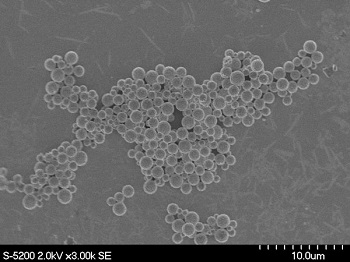 Under high-power microscopy, a powder made with detergent-based technology appears as perfect spheres. Consistency makes catalytic materials considerably more effective. Image courtesy of Hongyou Fanhydrogen.
The researchers use the active ingredient in cleaning solutions to trap raw materials, just like grease, encapsulating them inside cages made up of detergent molecules. The cage functions as a molecular mold that controls the morphology of the material forming inside. Clean, uniform porphyrin nanostructures are produced when the cage is removed.
These materials are being optimized for potential applications like energy conversion in solar cells, phototherapy for cancer treatment and hydrogen production for clean fuel sources by creating particles in new shapes. One detergent may yield spheres, but the researchers can swap it out for another that produces discs, rods or octahedrons.
Efforts are now devoted to developing a protocol to replicate specific shapes based on the detergent, temperature, pH value and concentration. Like turning knobs, they could adjust these inputs to get a reliable output.