Electric field-powered self-cleaning glass clears dust in seconds
Marie Donlon | August 13, 2025A team of researchers in China has created a transparent, self-cleaning glass capable of removing particles in about 10 seconds using an electric field.
According to the researchers, this water-free and sustainable alternative to traditional cleaning methods could potentially be applied to not only terrestrial vehicles and buildings but also to solar panels located on probes used on the surface of Mars.
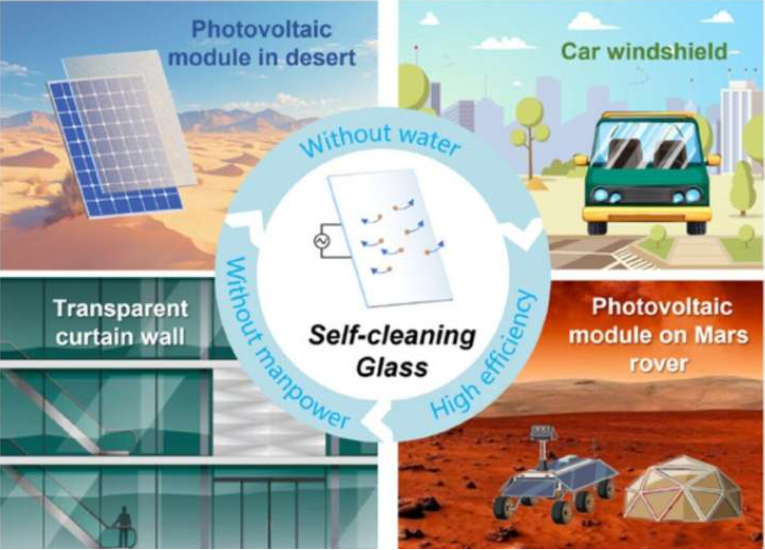 Source: Adv. Sci. (2025). DOI: 10.1002/advs.202509404
In the lab, the glass achieved self-cleaning of both organic and inorganic particles and demonstrated self-cleaning efficiency of more than 95% within mere seconds.
Conventional water and detergent cleaning methods tend to be a resource-intensive, environmentally polluting process that also involves concerns regarding the safety of manual cleaners, such as in the case of tall buildings.
However, the transparent, coverable self-cleaning glass exhibited removal of 97.79 g/m2 of particles in 10 seconds with 97.5% efficiency by employing a square wave electrical signal (5 kV, 10 Hz). The glass also exhibited a particle shielding effect that prevented moving particles from depositing onto the clean surface once the electric field was turned on.
The sandwich-like construction of the self-cleaning glass features a base layer that consists of quartz glass. Meanwhile, indium tin oxide (ITO) electrode/electrodes were subsequently applied to the glass layer laser etching. Then, the team applied a polyethylene glycol terephthalate (PET) film to serve as an insulating dielectric layer over the ITO electrodes.
The researchers suggest that understanding how the particles move and detach under electric fields holds the key to understanding and thus developing a self-cleaning surface that functions well in both waterless and harsh conditions on Earth and in outer space.
An article detailing the findings, “Coverable Self‐Cleaning Glass via Abnormal Transport and Jump of Charged Particles,” appears in the journal Advanced Science.