The Quantum Promise of 'Time Crystals'
Tony Pallone | May 29, 2018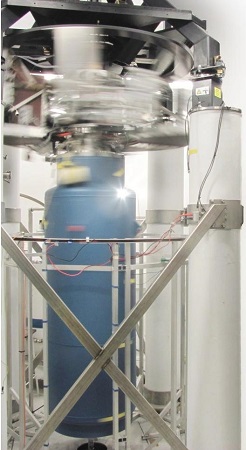 This cryostat is the type of device that researchers used to study time crystal formation. Source: Aalto University.It’s a claim currently under hot debate: whether or not “time crystals” can exist.
What are time crystals, you ask? Well, they’re just like three-dimensional crystals such as snowflakes or diamonds, which possess a repeating pattern in space – except that they also repeat in time. Diamonds remain unchanged as time passes, but time crystals constantly undergo spontaneous change, achieving a self-sustaining oscillation and breaking the symmetry of time in the process.
Sounds pretty sci-fi, but a study from Aalto University in Finland has offered new evidence of their physical viability. And that’s promising for the future of things like quantum information processing devices, which rely on long-term coherence – a property possessed by time crystals that derives from their temporal and spatial consistency.
“Nature has given us a system that wants to be coherent over time,' said Vladimir Eltsov, leader of the university’s ROTA research group. “The system spontaneously begins to evolve in time coherently, over long periods of time, even infinitely long.”
Until recently, there has been little experimental evidence of the phenomenon, despite numerous theoretical studies. An understanding of when and how time crystals materialize may lead researchers to develop the same sort of coherency in numerous types of devices. They may even make it possible to construct the boundary between time going forward and back, as the theory suggests.
Working in the university’s Low Temperature Laboratory, the researchers relied on the Bose-Einstein condensation of magnons in superfluid Helium-3 for their study – which has implications in other fields, as well. “Helium-3 is related to practically all branches of physics: gravity, topology, particle physics, cosmology,” said Grigori Volovik, a professor emeritus. Volovik is a global pioneer in the study of connections between cosmology, high-energy physics and condensed matter. “It is an entire universe of study,” he added.
The research appears in the May 25, 2018, edition of Physical Review Letters.