New standalone thermal camera starts instantly, targets hidden faults
Peter Brown | October 28, 2026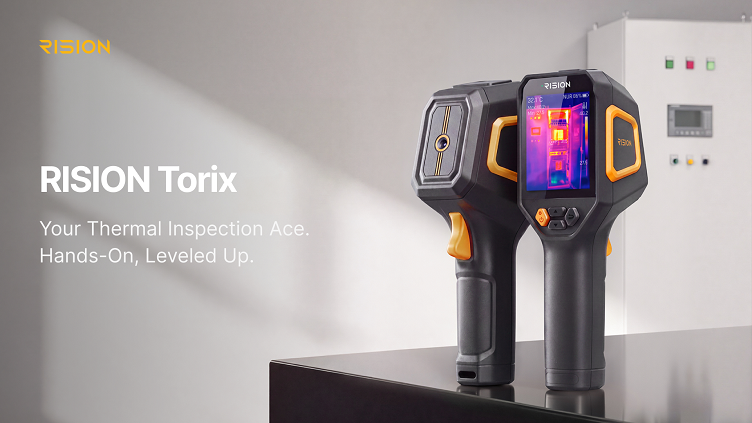 A standalone handheld thermal camera from Rison is a self-contained device for HVAC technicians, building inspectors, automotive specialists and more. Source: Rision
Hong Kong-based imaging and sensing vendor Rision has launched a standalone handheld thermal camera that works without a smartphone.
The fully self-contained thermal camera, dubbed Torix, is designed for those who work with both hands and inspect often. This includes HVAC technicians, building inspectors, automotive specialists or even do-it-yourself makers.
"It's built more rugged for users who need to work without worry in tougher environments,” said York Guo, founder and CEO of Rision. “We know how much time and money a single undetected fault can cost, whether it's an overheating panel or a hidden leak. Torix puts that visibility in your hands.”
The thermal imaging camera is built around a native 160 x 120 infrared sensor, and its image output is enhanced to 320 x 240 via Rision’s QuadIR super-resolution processing.
It features a thermal sensitivity of 40 mK or less to show subtle temperature differences and a 25 Hz frame rate for smooth scanning. Other features include a 2.6 mm fixed-focus lens and measurements of -4° F to 1,022° F (-20° C to 550° C) at ±2° C or ±2% accuracy.
This temperature range allows it to work for underfloor heating checks, electrical panels and high-temperature processes, Rision said.
Thermal imaging in a rugged form factor
According to the company, the Torix starts instantly and displays the image on a 2.8-inch screen with six color palettes. It has a 2,750 milliamp-hour (mAh) battery for 10 hours of continuous use. It can be recharged in 60 minutes, Rision said.
Additionally, it holds a charge in long-term storage. It also has IP54 protection against dust and splashes as well as a 2-meter drop resistance.
Thermal imaging with custom high and low temperature limits
The Torix triggers a visual red alert and automatically captures a full-radiometric image when either the custom high- or low-temperature limits are crossed.
Interval capture down to 10 seconds allows intermittent faults to be documented without the need for continuous screen monitoring, Rision said.
Images and video are saved to a removable SD card and transferred over USB-C or by removing the card.