Opening Polymer-forming Technologies to Glass
Tony Pallone | May 24, 2018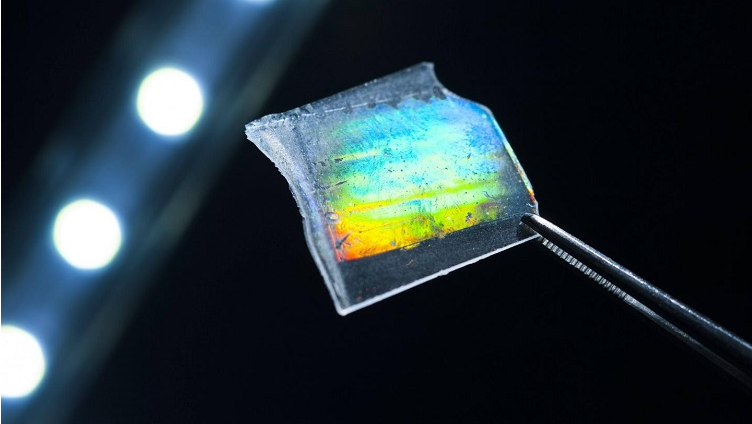 A glass-polymer mixture known as a 'Glassomer' can be processed just like conventional polymers. Source: Markus Breig, KIT.
Scientists at Karlsruhe Institute of Technology (KIT) in Germany have developed a new technique for industrial glass processing. By employing a simple structuring technology to treat quartz glass like a polymer, the method overcomes a longstanding challenge to maximize both quality and efficiency.
“We start with the smallest glass particles," said Dr. Bastian E. Rapp, head of the NeptunLab interdisciplinary research group of KIT's Institute of Microstructure Technology (IMT). Those particles - just 40 nanometers in size - are then mixed with a liquid polymer, formed into a structure like a sponge cake and hardened to a solid by heating or light exposure. The polymer acts like a bonding agent, maintaining the shape and retaining the glass particles at the right locations.
 Glass components similar to these can be produced by cutting Glassomer. Source: Markus Breig, KIT.The resulting composite structure, known as a “Glassomer,” consists of glass particles in a matrix at a ratio of 60 to 40 volume percent. It can be milled, turned, laser-machined or processed in CNC machines just like a conventional polymer.
"The entire range of polymer forming technologies is now opened for glass," Rapp noted.
For instance, to fabricate high-performance lenses used in smartphones, the scientists can produce a Glassomer rod from which the lenses are cut. Highly pure quartz glass - highly transparent and resistant to thermal, physical and chemical impacts - can also be formed by heating the lenses in a furnace at 500-600° C, burning the polymer to CO2 to remove it from the composite.
This opens up new opportunities for the glass processing industry as well as for the optical industry, microelectronics, biotechnology and medical engineering.
"Our process is suited for mass production,” said Rapp. “Production and use of quartz glass are much cheaper, more sustainable, and more energy-efficient than those of a special polymer."
The innovation is reported in the journal Advanced Materials. The NeptunLab also has reported previous innovations with quartz glass processing, including use of a liquid glass-polymer mixture for molding and also for 3D printing. Through the "NanomatFutur" competition for early-stage researchers, the team was funded with EUR 2.8 million by the Federal Ministry of Education and Research from 2014 to 2018. A spinoff now plans to commercialize Glassomer.