Scientists created bone substitute from 3D-printed glass
Marie Donlon | October 03, 2025A team of researchers from China’s Dalian University of Technology has developed a 3D printable bio-active glass that promises to function as an effective bone replacement material.
During trials conducted in rabbits, the material sustained bone cell growth outperforming both regular glass and a commercially available bone substitute.
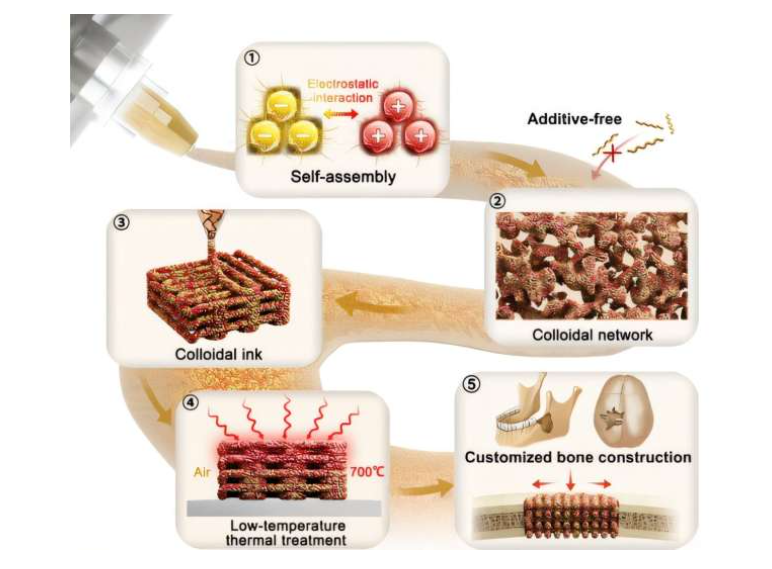 Source: ACS Nano (2025). DOI: 10.1021/acsnano.5c06377
According to the team, both bone and glass can bear weight better than they can withstand being stretched due to the crystalline structures of the molecules and minerals that form them. Yet, unlike bone, the main ingredient in glass — silica — can also exist in a liquid form and it can be 3D printed into any shape, for instance, into the shape of a missing section of bone.
Because 3D-printable glass tends to require toxic plasticizing agents or the glass needs to be fused at temperatures higher than 2,000° F, the researchers sought to develop a 3D-printable glass that didn't need plasticizers or extremely high temperatures to function as a scaffold for bone-forming cells.
To accomplish this, the team combined oppositely charged silica particles as well as calcium and phosphate ions — which are both known to promote bone cell formation — to create a printable, bio-active glass gel. Once the glass was shaped using a 3D printer, it was hardened into its final shape in a furnace at 1,300° F. The new bio-glass was then tested against a 3D printed plain silica glass gel as well as a commercially available dental bone substitute, both of which were used to fix skull damage in living rabbits.
The team found that while the commercial product grew bone faster, the bio-glass sustained growth longer. Following eight weeks, most of the bone cells present had formed on the bio-glass scaffold while the plain glass demonstrated barely any bone cell growth.
An article detailing the findings, “Rational Design of Purely Inorganic Self-Healing Colloidal Hydrogels To Enable “Green” 3D Printing of Bioglass-Based Bone Substitutes,” appears in the journal ACS Nano.