
Constructing Emergency Shelters with Used Plastic Bottles
Marie Donlon | May 10, 2018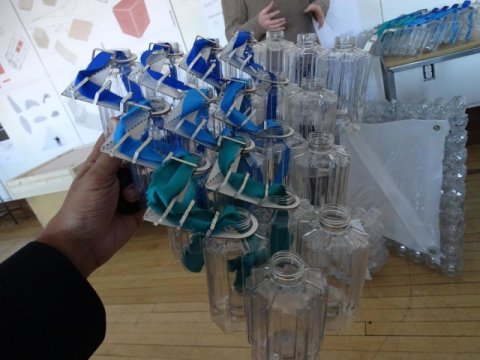 The project uses bottles created by Friendship Products LLC to construct a shelter for disaster relief. Source: RPIDisasters such as hurricanes and earthquakes have devastated locations the world over, particularly in recent years. With such disasters comes the need for food, water and shelter for those affected. As such, a team of researchers from New York's Rensselaer Polytechnic Institute (RPI) have been working on a solution to provide housing to those displaced by such disasters using unlikely building blocks: plastic water bottles.
Typically, after disaster strikes, supplies such as food, medicine and bottled water are sent to the affected location. With untold numbers of plastic bottled water sent to such sites, how the plastic bottles are disposed of after use become, understandably, a minor consideration.
Now, both students and faculty from RPI's schools of engineering and architecture are demonstrating how these plastic bottles might offer those displaced by a disaster temporary shelter. Using a series of interlocking plastic bottles manufactured by Friendship LLC, the team has assembled a structure with walls and columns of plastic bottles. To fortify the shelter, materials such as sand and dirt can be added to the bottles as the structure is being erected.
The structure, which is on display in front of the Greene Building on the RPI campus through May 12, is 15 square meters in size.
"This project presents a unique collaboration to optimize function and shape," said Mohammed Alnaggar, assistant professor of civil and environmental engineering. "The structural engineering research focusing on studying all the mechanics of the interlocking between the bottles and its scaling up to the full structural scale provides the architectural engineers with the needed properties to create not only an aesthetically appealing structure, but also a structurally sound and safe one."
"We are taking the bottles from our landfills and putting them sustainably into our structures to reduce weight and provide insulation for a better energy consumption," he said.
After being displayed at RPI, the structure will be brought to Industry City in Brooklyn for the WantedDesign event May 17-21.



Now that the RPI team has operationalized this idea it seems sorta obvious: use what you have on hand to solve a problem. I'm always blown away by the ingenuity involved in projects like this one.
What about making the bottle fit together like LEGO blocks. Kind of easy to make the walls. Gallon size. Now just need to figure out how to make a roof.
What is really needed is a total revolution in how we advertise and package products, not just for emergency situations but everyday consumption.
Our stores are full of products packaged in containers that serve only one purpose, to look different from the competitor so you will buy it,use it ,and throw away the useless packaging.
We should make "second use" a priority instead of filling up landfills or recycling.
A carefully designed modular system of containers of different volumes that will all interlock could contain many of our liquid and powdered products . Manufacturers could learn to distinguish their products from the competition with stick on labels , heat shrink wrap, or graphics applied directly on the container.
Interlocking containers of products could be strapped on pallets actually reducing the amount of packaging required for shipment
Once we gather enough empty containers, the usefulness has great potential- build a home, a wall, a floating dock,a patio,... get creative with real world building blocks.
Special edition containers could be windows, sinks or wheels. Temporary uses might snap together, while permanent uses might glue, hot melt glue , or ultrasonic weld together.
The outside texture or pattern could be varied to suit different uses. the rigidity or softness of the plastic could also vary- soft ones make furniture.
The containers may be filled with different substances for different purposes as well- water for a thermal mass, concrete for construction, air for flotation.
Why send our troops water in containers that get thrown away and sandbags to fill with sand ? Interlocking empty water containers filled with earth or sand would build walls and shelters.
We can stop worrying about biodegrading plastics, we will want our plastic containers to last as long as possible.
I have tried to convince people of the practicality of this concept for years, it's a big idea that just hasn't reached the right ears yet.
I believe that if just one company would start providing their product with such a container, it would be popular enough for others to follow suit. What kid wouldn't want to build a playhouse out of life-size legos ?
And non-creative people with no desire to build anything could still save their empty containers for other people that want them.
The empty container would have value, it would not be something that required expanding landfills.
In reply to #3
I did a little internet research and such products do exist (interlocking bottles or containers). The problem is I have never seen any of these products in real life (merchant shelves). Getting Relief Agencies behind these products would maybe bring these into the main stream and perhaps they would get a following after that. Plastic really never goes away (must recycle). So finding a practical use in it's original form would be beneficial.